Do Indian Universities Check for AI? Rules for Students in 2026
Do Indian universities check for AI? What UGC rules actually cover, what IIT Delhi, IISER Pune and ISB say about AI use, and what students should do.
Short answer: yes, many do, but there is no single national AI rule. What is regulated nationally is plagiarism: the UGC's 2018 regulations require universities to check theses and dissertations with approved software, and they say nothing about generative AI (UGC Regulations, 2018). Rules on AI use are set by each institution, and often by each teacher. If you want to see how an AI detector for India reads your work before you submit, you can check it free.
This guide separates what is actually written down from what is rumour, shows what named Indian institutions have published, and ends with what you should do as a student.
Try it: use ProofAI's check if ChatGPT wrote it, free for 10 checks a day with no login.
What the UGC regulates: plagiarism, not AI
The main national rule is the UGC (Promotion of Academic Integrity and Prevention of Plagiarism in Higher Educational Institutions) Regulations, 2018, notified on 23 July 2018 (UGC). Five points matter for students:
- It covers Master's and research work. Its definition of a "script" includes theses, dissertations and research papers, and expressly excludes "assignments / term papers / project reports / course work / essays and answer scripts" (UGC Regulations, 2018, clause 2). Your semester assignments are governed by your college's own rules.
- Software checks are compulsory. Institutions must use "appropriate software" to check theses and dissertations, and every student must sign an undertaking that the work was checked with a plagiarism detection tool approved by the institution (clause 6).
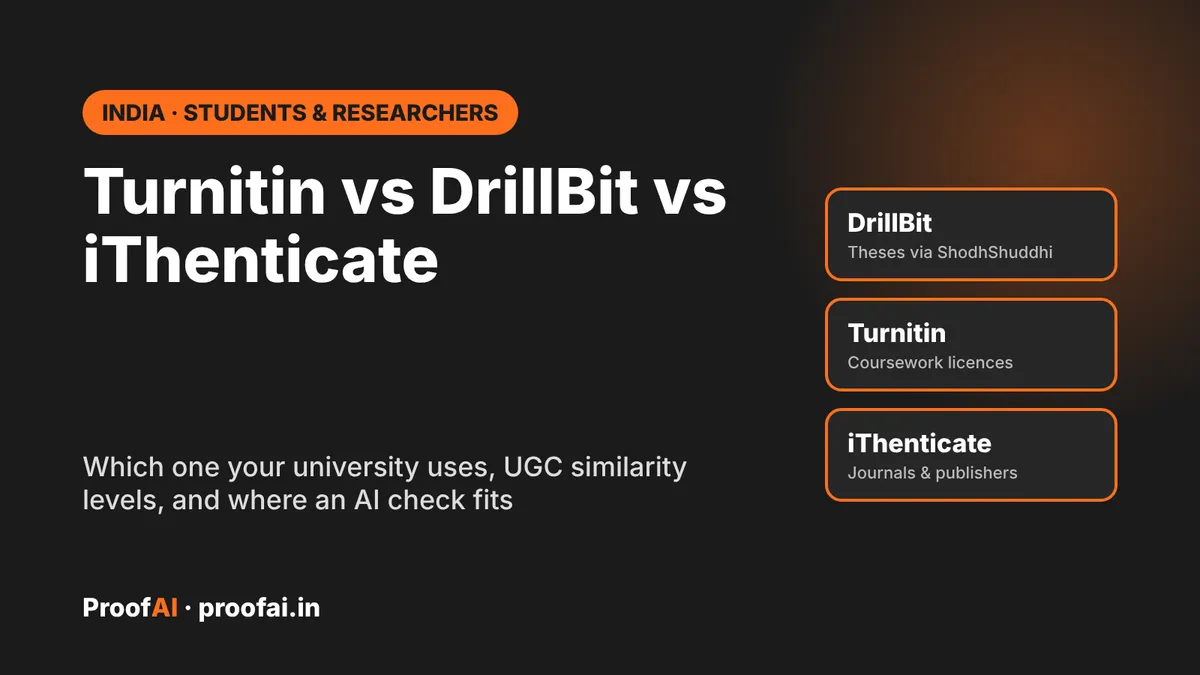
- Similarity has levels. Up to 10% similarity is Level 0 with no penalty; Level 1 (above 10% to 40%) means a revised script within six months; Level 2 and Level 3 bring a one-year debarment and cancellation of registration (clause 12.1). Our Turnitin vs DrillBit vs iThenticate guide explains these levels in detail.
- Cases go to panels. Departmental and institutional academic integrity panels investigate, must follow "the principles of natural justice", and penalties apply only after misconduct is established and appeals are exhausted (clauses 10-12).
- There is no AI clause. The text does not mention artificial intelligence or AI-generated writing at all. It defines plagiarism as "taking someone else's work or idea and passing them as one's own" (clause 2), which institutions may apply to undisclosed AI text, but that is an interpretation, not a written UGC rule.
The UGC PhD Regulations, 2022 repeat the same model: the institution must have software to detect plagiarism, and a PhD scholar submits the thesis with an undertaking that there is no plagiarism and a supervisor's certificate of originality (UGC, 7 November 2022, regulation 11). Again, AI is not mentioned.
Is there a UGC or government rule on ChatGPT?
We could not find one. As of November 2026 we found no UGC regulation, AICTE circular or Ministry of Education notification that sets rules for students' use of generative AI. Several coaching and thesis-help websites describe "UGC AI guidelines for PhD", but none of the ones we checked linked to a UGC notification, so we do not repeat their claims here. If one is issued, it will appear on the UGC website as a notification or public notice.
Want to check your own content? Try ProofAI free 10 checks a day, no login needed.
What does exist is narrower:
- School board exams. In February 2023 CBSE said using ChatGPT in the Class 10 and 12 board exams would amount to using unfair means (Deccan Herald / PTI). That is an exam-hall rule, not a policy for homework or college.
- International guidance. UNESCO's global guidance on generative AI in education recommends data-privacy protection and an age limit for independent use of AI chatbots (UNESCO). It is advice to governments, not binding on Indian universities.
What named Indian institutions have published
Institutions are writing their own rules, and they differ. A 2025 EY-Parthenon and FICCI survey of 30 leading Indian higher education institutions found that 60 per cent permit student use of AI tools and over 56 per cent have AI-related policies (Siasat / PTI). Some examples with sources:
| Institution | What it says | Source |
|---|---|---|
| IIT Delhi | AI-assisted work must be "fully disclosed"; AI-made images, tables or significant text should be noted in captions, footnotes or a statement (May 2025) | PTI via Dinamalar |
| IISER Pune | Institute-wide guidelines on generative AI in education and research; AI allowed unless a course teacher or PhD supervisor rules it out in writing | IISER Pune, Elets / Indian Express |
| ISB | No institution-wide rule; each faculty member decides whether AI is permitted, restricted or banned for a course or task | Elets / Indian Express |
| RV University, Bengaluru | Banned ChatGPT and other AI tools in early 2023, with teacher "spot checks" (we could not confirm whether this still applies) | University World News |
Two patterns stand out. First, disclosure is the common thread: IIT Delhi's guidelines also say students and researchers must take full responsibility for verifying the accuracy of their work (PTI via Dinamalar). Second, the teacher often decides. At IISER Pune most quizzes and semester exams still run without AI, even though AI is allowed in some coursework (Elets / Indian Express).
Also read: AI Detection for Universities: A Practical Policy Guide
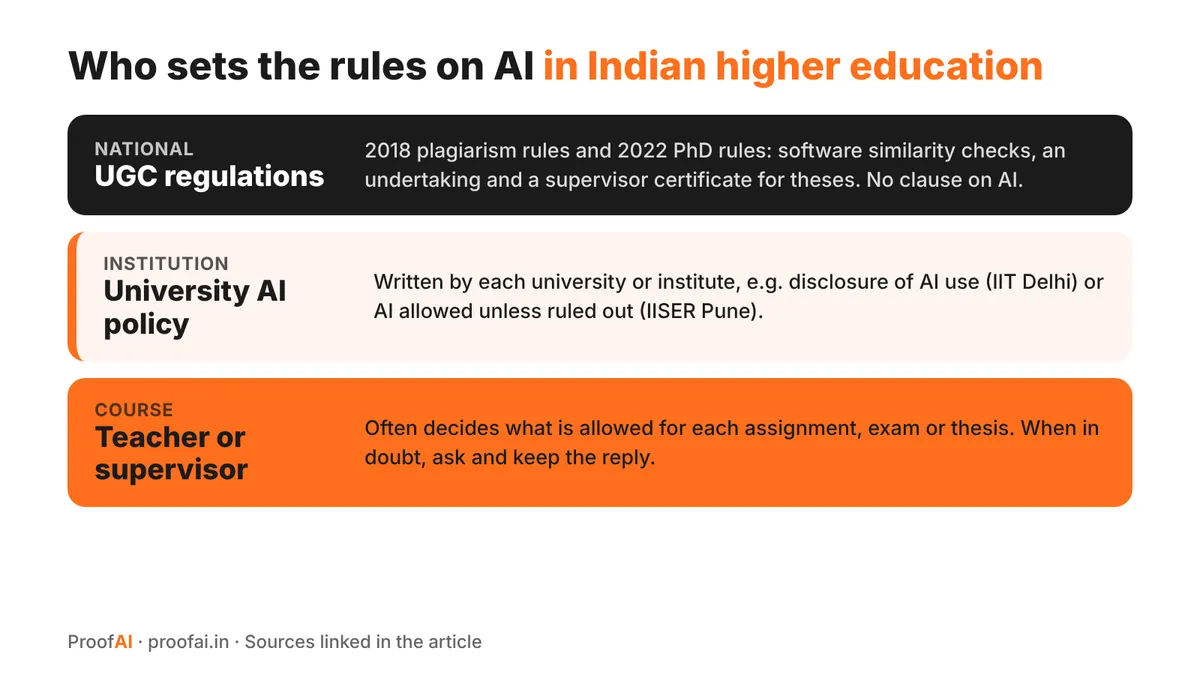
What is regulated in India: UGC plagiarism rules for theses, institution AI policies, and course-level rules set by teachers
So, do Indian universities actually check for AI?
For theses and dissertations, the check you are certain to face is a plagiarism (similarity) check. Many universities run it with DrillBit, which the Ministry of Education's ShodhShuddhi programme has provided to institutions through INFLIBNET since 1 October 2023 (ShodhShuddhi).
An AI writing check depends on the tool and the licence. Turnitin can produce a separate AI writing report on licences that include it, for files with at least 300 words of long-form prose (Turnitin). We explain how to read that number in Turnitin AI score explained. For coursework, your teacher may use an AI detector, ask you questions about your work, or compare it with your in-class writing. No rule says they must or must not.
What students should do
You do not need to guess. Follow these steps for every course and for your thesis:
- Ask before you use AI. Read the course outline and your university's policy page; under the UGC regulations every institution must place its approved plagiarism policy on its website homepage. If AI is not mentioned, email your teacher or supervisor and keep the reply.
- Disclose what you used. Say which tool, for what (grammar, outline, code, translation) and where. A one-line statement or footnote, the form IIT Delhi suggests (PTI), is enough in most cases.
- Keep your drafts. Google Docs or Word version history, notes, outlines and supervisor comments are the strongest evidence that the work is yours.
- Verify every reference. AI tools invent citations; at IISER Pune, evaluators checked AI-allowed assignments for hallucinated references (Elets / Indian Express).
- Self-check before submitting. Run your draft through an AI detector for Indian students and rewrite any passage that does not sound like you. ProofAI shows which sentences look AI-written, free each day without login. It does not replace your university's official report.
What an AI detector cannot tell anyone
Every AI detector, ProofAI included, gives a probability, not proof. Turnitin itself says its AI report "should not be used as the sole basis for adverse actions against a student" (Turnitin). Researchers at Stanford found that popular detectors flagged essays by non-native English writers far more often than essays by native speakers (Stanford HAI), which matters in India. If you are flagged, ask to see the highlighted passages, bring your drafts, and use the appeal route your institution sets out.
FAQ
Is using ChatGPT illegal for Indian students? No. No Indian law or UGC regulation bans students from using ChatGPT. Whether you may use it for a particular task is decided by your university, your course teacher or your supervisor.
Do UGC rules count AI-written text as plagiarism? The 2018 regulations do not mention AI. They define plagiarism as passing off someone else's work or idea as your own, and some institutions treat undisclosed AI text the same way, so check your university's own policy.
Does DrillBit or Turnitin detect AI writing? Turnitin can, where the institution's licence includes the AI writing report. DrillBit describes AI content checking as part of its platform, but whether your report includes it depends on your institution's setup.
Do I have to disclose AI use in my thesis? Where your university or supervisor requires it, yes. Even where nothing is written, a short disclosure of what you used and why protects you if questions come up later.
Can a university fail me only because of an AI detector score? Turnitin says its score should not be the sole basis for action, and UGC rules require plagiarism panels to follow natural justice. Ask for a review with your drafts if a score is used against you.
Conclusion
India regulates plagiarism in theses nationally, but AI use is left to each institution and often to each teacher. Read your university's policy, ask when it is unclear, disclose what you used, and keep your drafts. Those four habits will protect you whatever the rules say next year.
Published by
AI tools may assist with drafting; a team member checks and approves every article before it is published. How we write and correct articles.
Popular AI detection tools
Ready to Verify Your Content?
Get weekly insights on AI detection. Start your journey toward digital authenticity with our AI detection tools.