Can ChatGPT Tell If It Wrote Something? (No, and Here's Why)
Can ChatGPT detect its own writing? No. What OpenAI says, why its own AI classifier was shut down, and what teachers and students can do instead to check a text.
Short answer: no. If you paste an essay into ChatGPT and ask "did you write this?", the answer you get is a guess. OpenAI itself says ChatGPT has no knowledge of what content could be AI-generated, and that its answers to this question have no basis in fact. It may say "yes" to a text a student wrote by hand, and "no" to a text it produced a minute ago.
This guide explains why, what happened to OpenAI's own AI detector, and what actually helps when you need to know whether a text was written with ChatGPT.
Try it: use ProofAI's ChatGPT checker, free for 10 checks a day with no login.
What OpenAI says
OpenAI's FAQ for educators is direct about this. As quoted by Business Today, it says ChatGPT has no "knowledge" of what content could be AI-generated, and that responses to questions like "did you write this?" are random and have no basis in fact.
The same FAQ also says that tools claiming to detect AI-generated content, including OpenAI's own, have not proven to reliably tell AI-written and human-written text apart. OpenAI reported that when it tested detection, content like Shakespeare and the Declaration of Independence was sometimes labelled as AI-generated.
Why ChatGPT cannot recognise its own writing
ChatGPT does not look up your text in a record of everything it has written for other people. When you ask it whether it wrote something, it does what it always does: it predicts a plausible-sounding reply. "Yes, this looks like AI writing" and "No, this seems human" are both plausible replies, so the answer can change if you ask twice or phrase the question differently.
Want to check your own content? Try ProofAI free 10 checks a day, no login needed.
Polished, formal writing is also exactly what a human student produces when they work hard on an essay. A model asked to judge "does this sound like me?" has no reliable way to separate a careful human writer from itself.
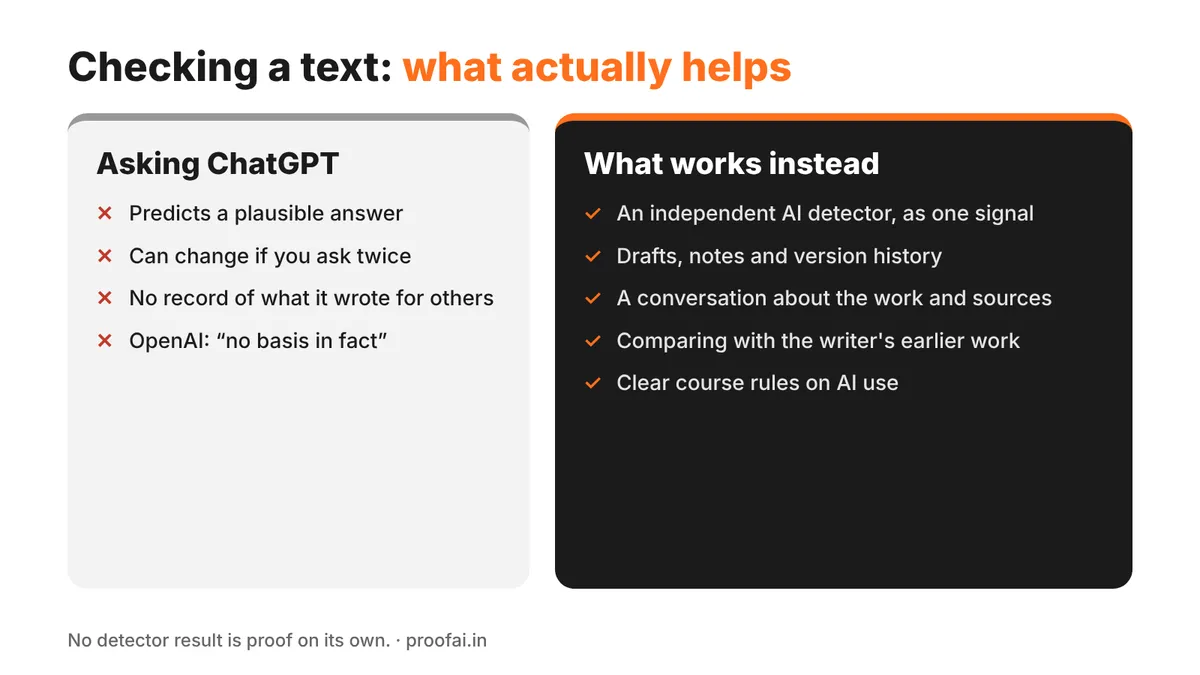
Asking ChatGPT vs what actually helps when you need to check a text
What happened to OpenAI's AI detector
OpenAI did build a tool for this. Its AI text classifier, released in 2023, was shut down in July 2023 because of its low accuracy, and OpenAI said it was working on better ways to verify where text comes from (Business Today). There is no official "ChatGPT checker" from OpenAI today.
Also read: AI Detector vs Plagiarism Checker: What's the Difference?
That history is a useful reminder for anyone using any detector: results are probabilities, not proof.
What works instead
For teachers and reviewers
- Use an independent AI detector, not the chatbot. A ChatGPT checker is built and tested for this job and shows which passages look most AI-written. Treat the score as a signal to look closer, never as a verdict.
- Talk to the student. OpenAI's own guidance suggests asking questions about the content to see how well the student understands their work. Someone who wrote an essay can usually explain their argument and sources.
- Ask for the process. Drafts, notes and version history (Google Docs and Word both keep it) show how a text grew.
- Compare with earlier work. A sudden change in style is a reason to have a conversation, not proof.
For students
- Keep your drafts and version history. It is the strongest evidence if your work is ever questioned.
- Check your own file before you submit with an AI detector for PDFs and Word files, and rewrite any passage that reads as generic in your own words and with your own examples.
- Follow your course rules on AI use and disclose it where you are asked to.
- If you are accused because someone asked ChatGPT, calmly point out that OpenAI says ChatGPT cannot tell whether it wrote a text, and offer your drafts and a conversation about your work.
Does ProofAI work like ChatGPT here?
No. ProofAI does not ask a chatbot "did you write this?". It analyses the text with detection models and returns an AI probability with the passages that drove it, free for 10 checks a day without an account (free AI detector). Like every detector it can be wrong, especially on short, formulaic or heavily edited text, so a result should always lead to a human review.
FAQ
Can ChatGPT detect if it wrote something? No. OpenAI says ChatGPT has no knowledge of what content could be AI-generated, and its answers to "did you write this?" have no basis in fact.
Does OpenAI have an AI detector? Not today. OpenAI shut down its AI text classifier in July 2023 because of its low accuracy.
Is it fair to fail a student because ChatGPT said it wrote their essay? No. ChatGPT's answer is not evidence. Look at the student's drafts, talk to them about the work, and use an independent detector only as one signal among several.
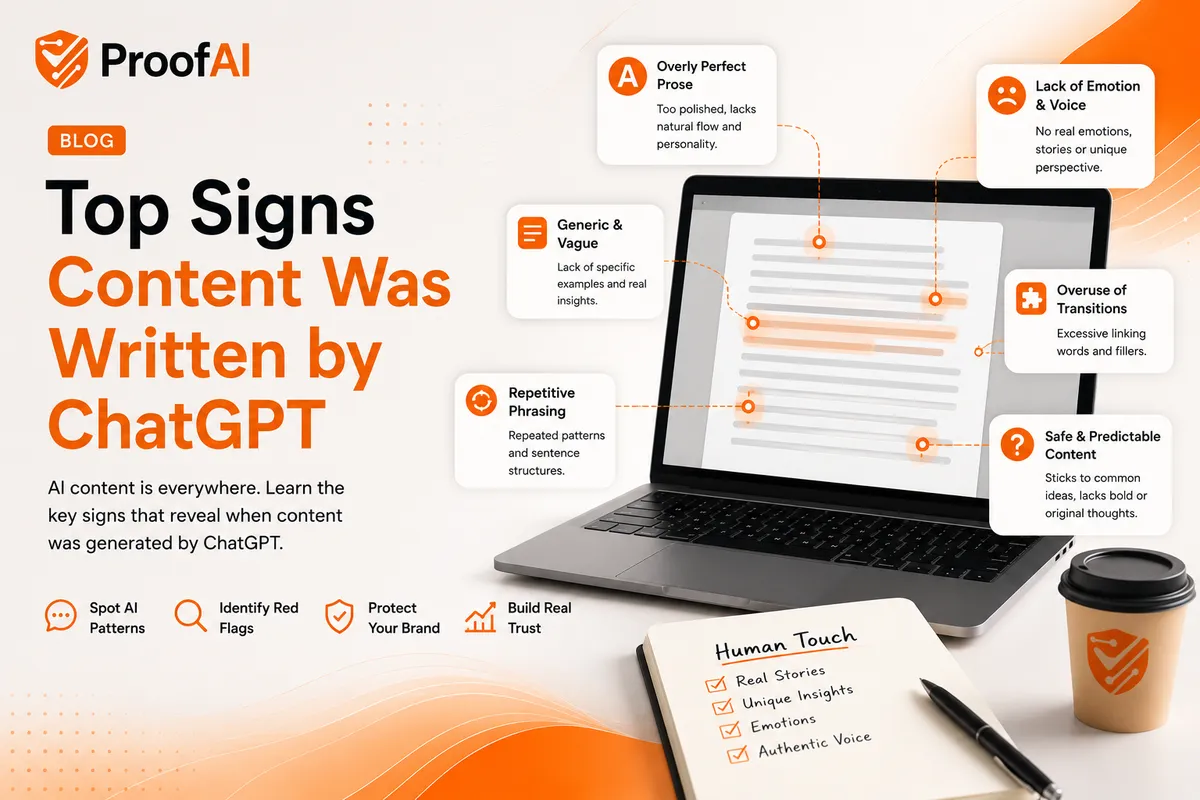
How can I check if a text was written by ChatGPT? Use an independent ChatGPT checker, read the highlighted passages yourself, and look at the context: drafts, sources and how well the writer can explain the work. Our guide to the signs of ChatGPT writing explains what to look for.
Can Gemini or Claude tell if they wrote a text? The same problem applies to any chatbot: asked whether it wrote a text, it predicts a plausible answer rather than checking a record. Use a dedicated detector instead.
Conclusion
Asking ChatGPT whether it wrote something feels like a shortcut, but it gives a guess, not an answer. Use an independent detector as a starting point, then look at drafts and talk to the writer. That is fairer to students and far more reliable for teachers.
Published by
AI tools may assist with drafting; a team member checks and approves every article before it is published. How we write and correct articles.

Popular AI detection tools
Ready to Verify Your Content?
Get weekly insights on AI detection. Start your journey toward digital authenticity with our AI detection tools.