Does Google Penalize AI-Generated Content? What Google Actually Says
Does Google penalize AI content? Not for being AI. What Google's own guidance says about AI content, scaled content abuse and E-E-A-T, and how to use AI safely.
Short answer: no, not for being AI. Google says its ranking systems reward original, high-quality content "however it is produced", and that appropriate use of AI is not against its guidelines (Google Search Central, February 2023). What Google does act against is content made mainly to manipulate rankings, and mass-produced pages that add nothing for readers, whether a person or a model wrote them. If you publish with AI help, a quick pass through an AI text detector is one way to find the drafts that still read like unedited machine output.
This guide sets out what Google has actually published on AI content, where the line between "helpful" and "spam" sits, and a practical workflow for bloggers, publishers, agencies and students who write for websites.
Try it: use ProofAI's AI checker tool, free for 10 checks a day with no login.
What Google says about AI-generated content
Google's clearest statement is its Search Central blog post Google Search's guidance about AI-generated content, published on 8 February 2023 by Danny Sullivan and Chris Nelson for the Search Quality team. The key points, in Google's own framing:
- Quality matters, not the method. Google's systems "aim to reward original, high-quality content" that shows E-E-A-T: experience, expertise, authoritativeness and trustworthiness.
- AI is not banned. Google compares it to an earlier rise in mass-produced human-written content: banning all human content would not have been reasonable, so it improved its systems to reward quality instead.
- Manipulation is the problem. Using automation, including AI, "with the primary purpose of manipulating ranking in search results" violates Google's spam policies.
- AI gives no ranking boost either. In the FAQ of the same post, Google says using AI "doesn't give content any special gains. It's just content."
That last point is worth repeating to anyone who expects AI to be either a shortcut or a curse. Google's position is neutral about the tool and strict about the result.
What counts as spam: scaled content abuse
In March 2024 Google added three new spam policies, one of them scaled content abuse (Google Search Central, March 2024). Google defines it as many pages generated "for the primary purpose of manipulating search rankings and not helping users", typically large amounts of unoriginal content of little or no value.
Want to check your own content? Try ProofAI free 10 checks a day, no login needed.
Google's announcement explains that this replaced the older policy on "automatically-generated content" and now applies "no matter whether content is produced through automation, human efforts, or some combination" of both. So a team of writers churning out thin pages is just as exposed as a script calling a language model.
Google's current spam policies page lists examples of scaled content abuse, including:
- Using generative AI tools to generate many pages without adding value for users.
- Scraping feeds or search results and republishing them, including with automated synonym swaps or translation.
- Stitching together content from different pages without adding value.
- Creating many pages that make little sense to a reader but contain search keywords.
What happens to sites that break these policies? The same page states that they "may rank lower in results or not appear in results at all", and that a manual action can follow human review. Site owners are notified in Search Console and can request reconsideration, according to the March 2024 announcement.
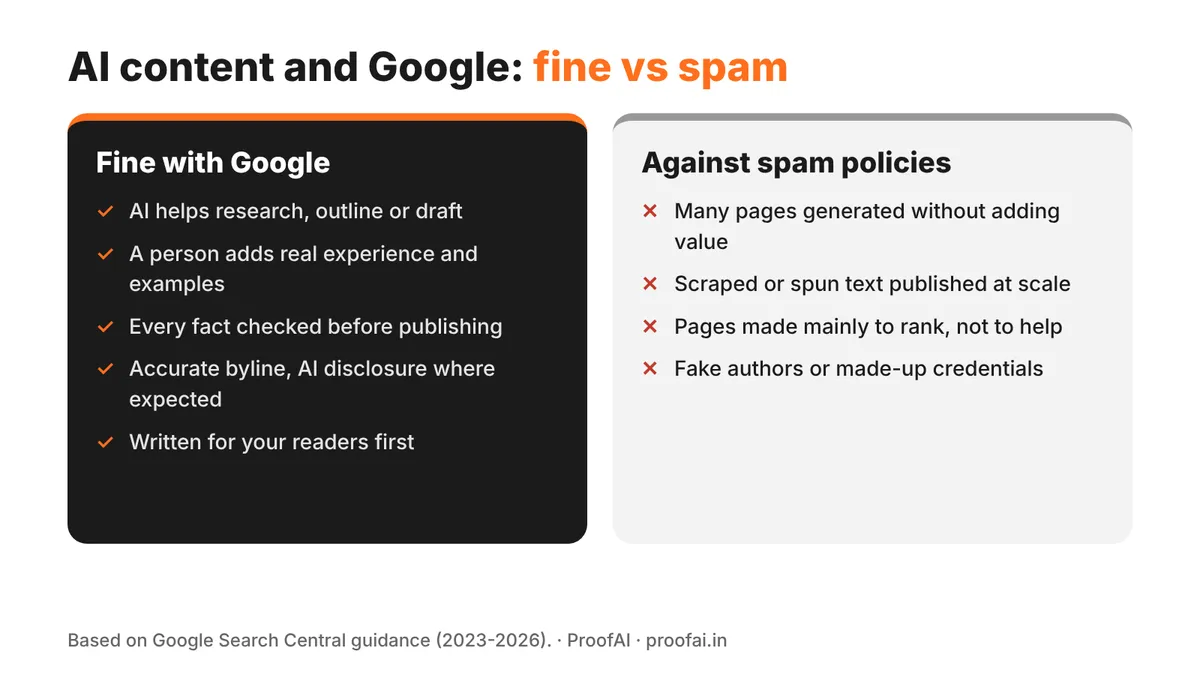
What is fine with Google when you use AI, and what is against its spam policies
People-first content and E-E-A-T
Google's help page Creating helpful, reliable, people-first content is the best checklist for any article, AI-assisted or not. It asks whether your content shows first-hand expertise (for example, from having actually used a product or visited a place), whether readers will leave feeling they learned enough, and whether your site has a clear focus.
The same page lists warning signs of "search engine-first" content. Several of them describe exactly how AI tools get misused:
Also read: How to Spot AI-Generated Fake Reviews Before You Buy
- Using extensive automation to produce content on many topics.
- Mainly summarising what others have said without adding much value.
- Writing about trending topics only for the traffic, not for your audience.
- Writing to a particular word count because you heard Google prefers one. Google's answer: "No, we don't."
On E-E-A-T, Google says trust is the most important part, and that E-E-A-T is not itself a specific ranking factor but a quality its systems try to identify through many signals (Google Search Central). For "Your Money or Your Life" topics such as health, finance and safety, its systems give even more weight to strong E-E-A-T.
Who, How and Why
Google suggests asking three questions about every page (people-first content guide):
| Question | What Google asks | What it means if you use AI |
|---|---|---|
| Who created it? | Is the author clear, with a byline where readers expect one? | Use a real, accurate byline. Fake authors, AI-generated headshots or made-up credentials are called out as deception. |
| How was it made? | Would readers benefit from knowing how it was produced? | Where someone might ask "How was this created?", consider explaining how AI or automation was used. |
| Why was it made? | Is it made mainly to help people, or to attract search visits? | If the main purpose is to manipulate rankings, AI use becomes a spam-policy problem. |
On bylines specifically, Google's AI content FAQ says listing AI as the author is "probably not the best way" to make AI involvement clear to readers.
How to use AI responsibly when you write for the web
Google's dedicated page on using generative AI content says AI can be useful for researching a topic and adding structure to original content, and it warns that generative models "don't retrieve facts" and may hallucinate. It calls manual fact-checking of all AI-generated content "critical", including titles, meta descriptions, structured data and image alt text. A workflow that follows that guidance:
- Start from what you know. Note the experience, data, examples or opinions only you can add before you open an AI tool. This is the part Google's people-first questions reward.
- Use AI for the scaffolding. Outlines, first drafts of routine sections, summaries of your own notes. Do not let it invent facts, quotes or statistics.
- Edit like an editor. Cut generic filler, add specifics, rewrite in your own voice, and make sure the page answers the reader's question faster than the pages already ranking.
- Fact-check every claim against a primary source and link it. Check the metadata too, as Google recommends.
- Add an honest byline and, where readers would expect it, a short note on how AI was used.
- Publish less, better. A small number of pages that genuinely help will serve you better than many thin ones, which is exactly the pattern scaled content abuse describes.
For students writing for a website, a client or an internship, the same rules apply, plus one more: follow your institution's or employer's policy on AI use and disclose it when asked.
Using an AI detector as a quality step
An AI detector cannot tell you whether Google will rank a page. Google does not say it uses third-party detectors, and its stance is about quality, not origin. What a detector can do is act as an early warning in your editorial process: drafts that come back looking heavily AI-written are often the ones that were not edited enough, with generic phrasing and no first-hand detail.
Many content teams use it like this:
- Agencies and editors check freelance submissions before they go to a client, then ask for revisions or sources where a draft reads as unedited output.
- Publishers spot-check articles before publishing as part of a wider review. Our page on content verification for publishers explains how that fits into an editorial workflow.
- Bloggers check their own AI-assisted drafts and rework the passages that feel generic.
ProofAI's AI text detector returns an AI probability with the passages that drove it, and you can upload PDF or Word files with the document detector. You get free checks every day without logging in, and more with a free account.
What a detector cannot do
No AI detector, ProofAI included, is always right. Human writing can be flagged, especially formal or formulaic text, and edited AI text can pass. We explain why in AI detector false positives. Treat a score as a prompt to read the text more closely, never as a verdict on a writer, and never as a prediction of rankings.
FAQ
Does Google penalize AI content? Not for being AI-generated. Google says appropriate use of AI is not against its guidelines, but using AI mainly to manipulate rankings is spam (Google Search Central).
Is AI content bad for SEO? Only if it is unhelpful. Google says AI content gets no special gains and no special penalty: if it is useful, original and shows E-E-A-T it can do well, and if it is not, it probably won't.
What is Google's AI content policy? There is no separate AI policy. AI content is judged by the same rules as everything else: the spam policies, especially scaled content abuse, and the people-first content guidance.
Should I disclose that I used AI? Google suggests AI or automation disclosures where readers might reasonably ask "How was this created?", together with accurate author bylines (Google's FAQ).
Can Google detect AI-generated content? Google has not said it labels pages as AI-written for ranking. It says systems such as SpamBrain look for spam patterns "however it is produced" (Google Search Central), so the useful question is whether your content is helpful, not whether it can be detected.
Conclusion
Google does not penalize content for being written with AI; it penalizes content made to game search, and mass-produced pages that add nothing. Use AI as a tool, add the experience and checking only a person can provide, be honest about authorship, and use an AI detector as one quality check before you publish. Rankings are never guaranteed, but helpful content is the only approach Google's guidance supports.
Published by
AI tools may assist with drafting; a team member checks and approves every article before it is published. How we write and correct articles.


Popular AI detection tools
Ready to Verify Your Content?
Get weekly insights on AI detection. Start your journey toward digital authenticity with our AI detection tools.