Is QuillBot's AI Detector Accurate? What It Checks and Its Limits
Is the QuillBot AI detector accurate? What it checks, its free limits, what benchmarks and independent tests show, and how to use any AI detector fairly.
Short answer: QuillBot's AI detector does well on benchmark tests of clearly AI-written text, but like every detector it gives an estimate, not proof. Results change with text length, editing and the AI model used, and two detectors can disagree on the same essay. If you want a second opinion, run the same text through a free AI detector and read the highlighted passages yourself before you decide anything.
This guide explains what QuillBot's AI detector checks, its free limits, what the published tests say, why scores differ between tools, and how to use any detector fairly.
Try it: use ProofAI's AI detector tool, free for 10 checks a day with no login.
What QuillBot's AI detector is
QuillBot is best known as a paraphrasing and writing tool. Its AI detector is one tool inside that writing suite, next to the paraphraser, grammar checker, summariser and plagiarism checker. You paste text and the detector estimates how much of it looks AI-generated, AI-refined or human-written, and highlights the sentences that drove the result (QuillBot AI Detector).
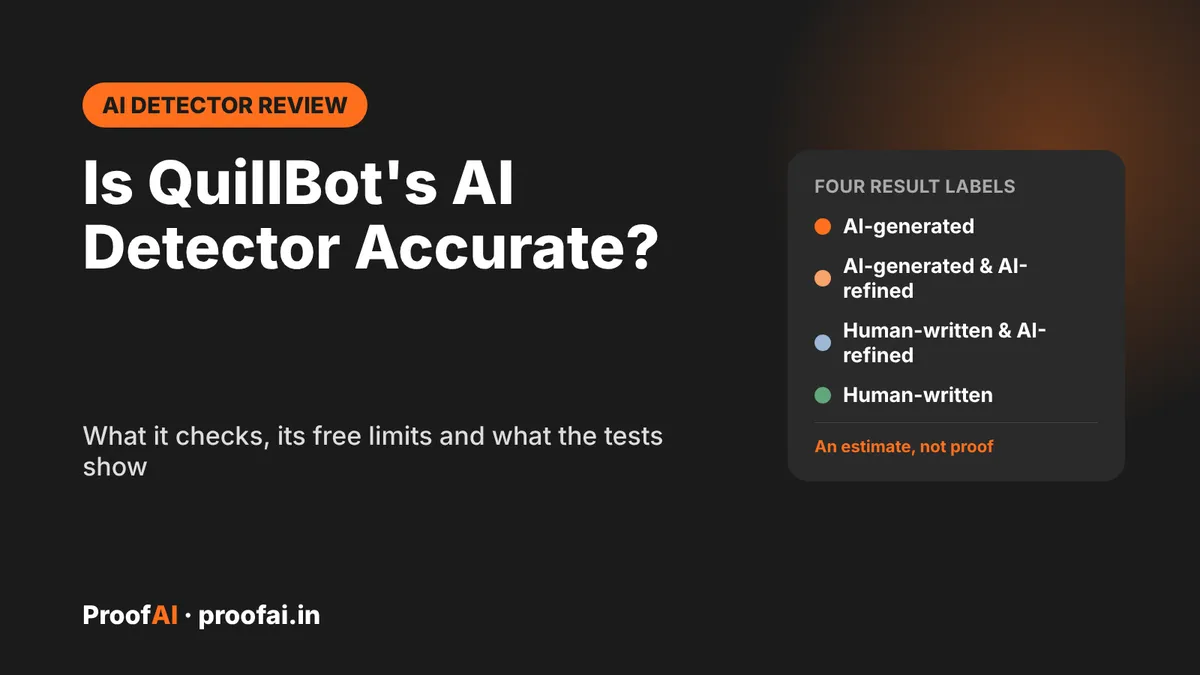
The four labels matter, because they are not simply "AI" or "human". QuillBot separates text that was generated by AI from human writing that was polished with AI tools (QuillBot AI Detector). That is useful when a student has used a grammar or rewriting tool on their own draft, which many schools allow.
Free limits and what you get
QuillBot's detector page lists these limits for free and Premium users (QuillBot AI Detector, QuillBot Premium):
| QuillBot Free | QuillBot Premium | |
|---|---|---|
| Scans | Up to 6 a day | Unlimited |
| Words per scan | Up to 1,200 | No word limit |
| Minimum text | 80 words | 80 words |
| Explanations | 1 explainer card per scan | Downloadable reports |
| Price in India | ₹0 | ₹334/month billed annually |
QuillBot notes that usage limits "may vary", so check its page before you rely on a number. The detector page describes pasted text; for a PDF or Word file you copy the text in first.
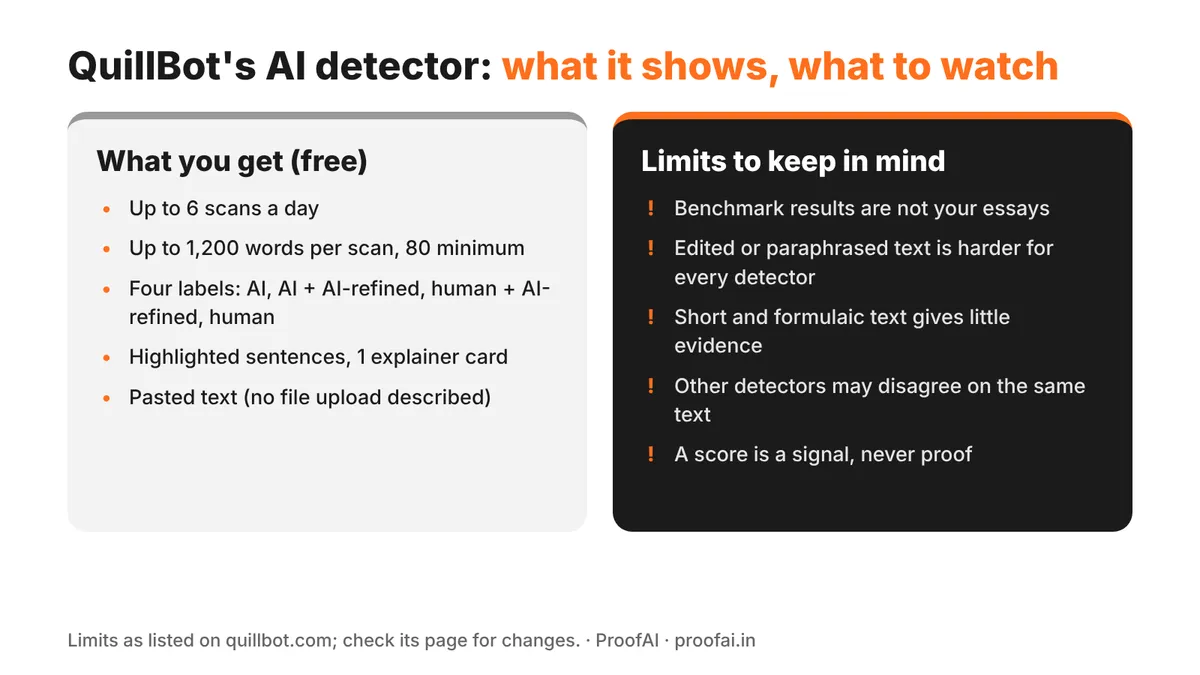
What QuillBot's AI detector shows and the limits to keep in mind
What the tests say about accuracy
There are three kinds of evidence, and they answer different questions.
Want to check your own content? Try ProofAI free 10 checks a day, no login needed.
QuillBot's own claim: the RAID benchmark
QuillBot says its detector reaches a 99% detection rate in independent RAID benchmark runs, and that when a result is unclear, its model leans towards "human" to reduce false positives (QuillBot AI Detector).
RAID is a real, academic benchmark from the University of Pennsylvania. Its paper describes over 6 million AI generations across 11 models, 8 domains and 11 adversarial attacks, and found that many detectors were "easily fooled" by unseen models and changes in how text is generated (Dugan et al., RAID, arXiv). Detector makers run the public test set themselves and submit their predictions, which RAID then scores (RAID on GitHub).
Also read: AI Detector False Positives: Why Human Writing Gets Flagged
QuillBot's leaderboard entry, submitted by QuillBot, shows it catching about 99.6% of the AI texts when the threshold is set so that 5% of human texts would be flagged, and about 98.1% when only 1% of human texts may be flagged (RAID results file for QuillBot). That is a strong result on that benchmark. It does not mean 99 out of 100 verdicts on your students' essays will be right: the benchmark measures how much AI text is caught at a fixed false-alarm rate, on its own mix of texts.
A journalist's hands-on test
ZDNet's David Gewirtz has run the same five texts (two written by him, three by ChatGPT) through a set of detectors for several years. In his October 2025 round, QuillBot classified all five correctly, but he also wrote that in his first tests its results were "wildly inconsistent", with repeated passes of the same text giving very different scores (ZDNet). Five texts is a small test. It shows the tool improved, not how it performs on your kind of writing.
Research on AI detectors in general
We found no peer-reviewed study that tests QuillBot's detector by itself, so we will not quote a number for it from the research. The studies that test many detectors are still useful as a warning:
- A study of 14 detection tools found all of them below 80% accuracy on its test set, with performance getting worse when AI text had been manually edited or machine-paraphrased (Weber-Wulff et al., 2023).
- A Stanford study found seven popular detectors flagged 61.22% of essays by non-native English writers as AI-generated on average, while essays by US eighth-graders were classified almost perfectly (Liang et al., 2023). QuillBot's detector was not part of that study, but the risk applies to any detector used on second-language English.
Why QuillBot and other detectors give different scores
It is common to get "8% AI" from one tool and "70% AI" from another on the same essay. In the Stanford study, 89 of 91 human-written TOEFL essays were flagged as AI by at least one of the seven detectors (Liang et al., 2023). The main reasons:
- Different training data. Each detector learned from its own collection of human and AI text. A tool trained heavily on one model's output can be weaker on another.
- Different thresholds. Some tools lean towards "human" when unsure, as QuillBot says it does. Others lean the other way. The same evidence then produces different labels.
- Different labels. QuillBot reports AI-refined text as its own category. A tool that only says "AI" or "human" has to put that text on one side.
- Length and type of text. Short texts, lists, definitions and formulaic writing give a detector little to work with. That is why QuillBot asks for at least 80 words.
- Editing. Text that was heavily edited by a person, or rewritten by a tool, is harder for every detector (Weber-Wulff et al., 2023).
None of this means one tool is "right" and the other "wrong". It means a score is one signal, and a big disagreement between two detectors is itself a reason to look more closely before you decide anything.
How to use any AI detector fairly
Whether you use QuillBot, ProofAI or another tool, these steps protect both the reader and the writer:
- Check enough text. Use whole paragraphs, ideally several hundred words, not single sentences.
- Read the highlighted passages. A high score driven by a reference list or a standard introduction means something different from a high score across every section.
- Remember what is allowed. If your rules let students use grammar or paraphrasing tools on their own drafts, an "AI-refined" result may be within the rules.
- Look at the context. Drafts, version history, notes and earlier work say more about how a text was written than any score.
- Talk to the writer. If the result matters (a grade, a job application, a publication), ask them to explain their work and sources.
- Never decide on one score alone. Not ours, not QuillBot's, not any tool's.
Where ProofAI fits
ProofAI is a stand-alone AI detector built in India, with prices in rupees. It does one job, detection, and checks:
- Text from 50 words, with the passages that drove the score highlighted, in the AI text detector.
- Files: PDF, DOCX, DOC and TXT up to 25 MB on every plan, uploaded directly, in the document checker.
- Images for signs of AI generation. Video detection is coming soon.
It is free for 10 checks a day without logging in and 25 a day with a free account. If you already pay for QuillBot Premium for its writing tools, its detector may be all you need. If detection is your main job, you check whole files, or you want a second opinion on a disputed result, compare the two on the QuillBot AI detector alternative page. ProofAI can be wrong too, especially on short, formulaic or heavily edited text; our published test method and results are on the accuracy page.
FAQ
Is QuillBot's AI detector accurate? On the RAID benchmark it catches most AI-written text at a fixed false-alarm rate, according to the results QuillBot submitted (RAID). On real essays its results, like every detector's, depend on length, editing and the AI model used, so treat a score as a signal, not proof.
Is the QuillBot AI detector free? Yes, with limits. QuillBot lists up to 6 free scans a day of up to 1,200 words each, with a minimum of 80 words; Premium removes the scan and word limits (QuillBot).
Can QuillBot's AI detector tell if I used QuillBot's paraphraser? QuillBot separates AI-generated text from human writing that was refined with AI tools (QuillBot). Research shows paraphrased and edited text is harder for detectors in general, so no tool can promise to catch it every time.
Why does QuillBot say my text is human but another detector says AI? Detectors are trained on different data, use different thresholds and report different categories. When two tools disagree strongly, read the highlighted passages and look at drafts and context before drawing a conclusion.
Can a teacher fail a student because of a QuillBot AI score? A score alone should not decide that. Use it as a reason to look at drafts, version history and earlier work, and to talk to the student about how they wrote it.
Conclusion
QuillBot's AI detector is a capable, free tool with a strong benchmark result, especially useful if you already use QuillBot for writing. But no detector, QuillBot's or ours, is accurate enough to judge a person on one number. Check enough text, compare tools when it matters, and let drafts and a conversation have the final word.
Published by
AI tools may assist with drafting; a team member checks and approves every article before it is published. How we write and correct articles.
Popular AI detection tools
Ready to Verify Your Content?
Get weekly insights on AI detection. Start your journey toward digital authenticity with our AI detection tools.