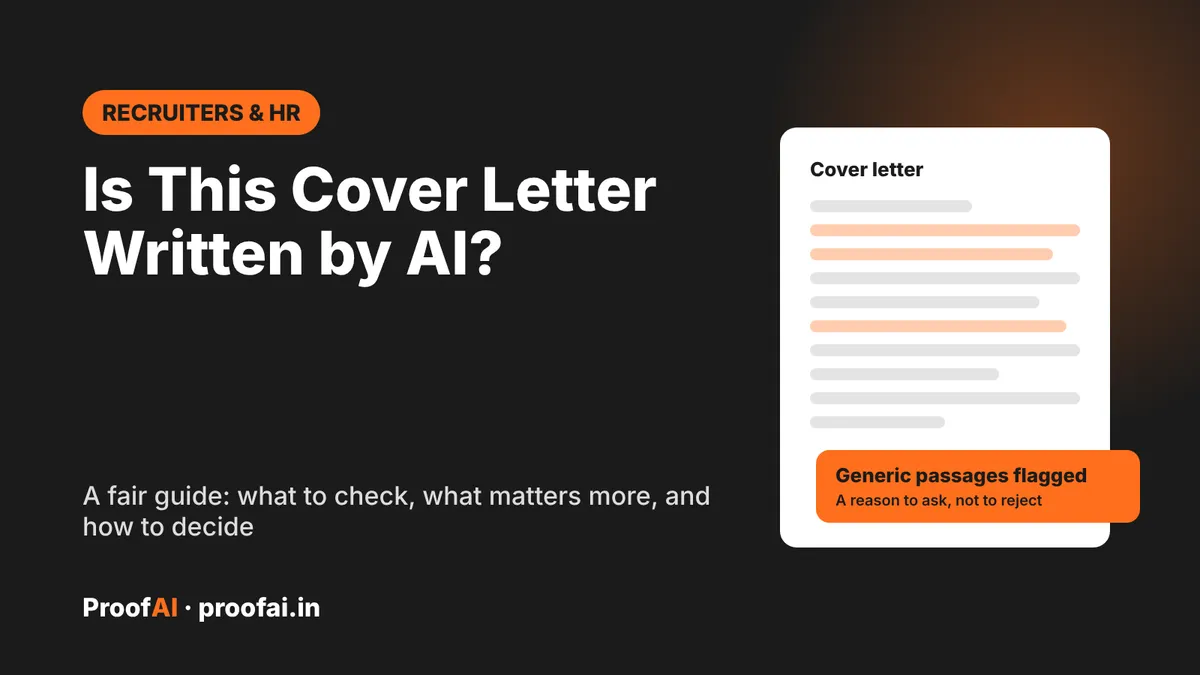
Is This Cover Letter Written by AI? A Fair Guide for Recruiters
Is this cover letter written by AI? How recruiters can use an AI cover letter checker fairly, which signals matter more, and how candidates can use AI responsibly.
Short answer: you often cannot tell for sure, and you do not need to. A cover letter that reads as generic may have been written with ChatGPT, or by a nervous candidate following a template. An AI cover letter checker gives you a useful signal, but the fairer question is whether the letter tells you anything true and specific about the person. This guide is part of our Resume AI Detector hub for recruiters and covers what AI-written letters look like, how to check one, and what to rely on instead.
What an AI-written cover letter tends to look like
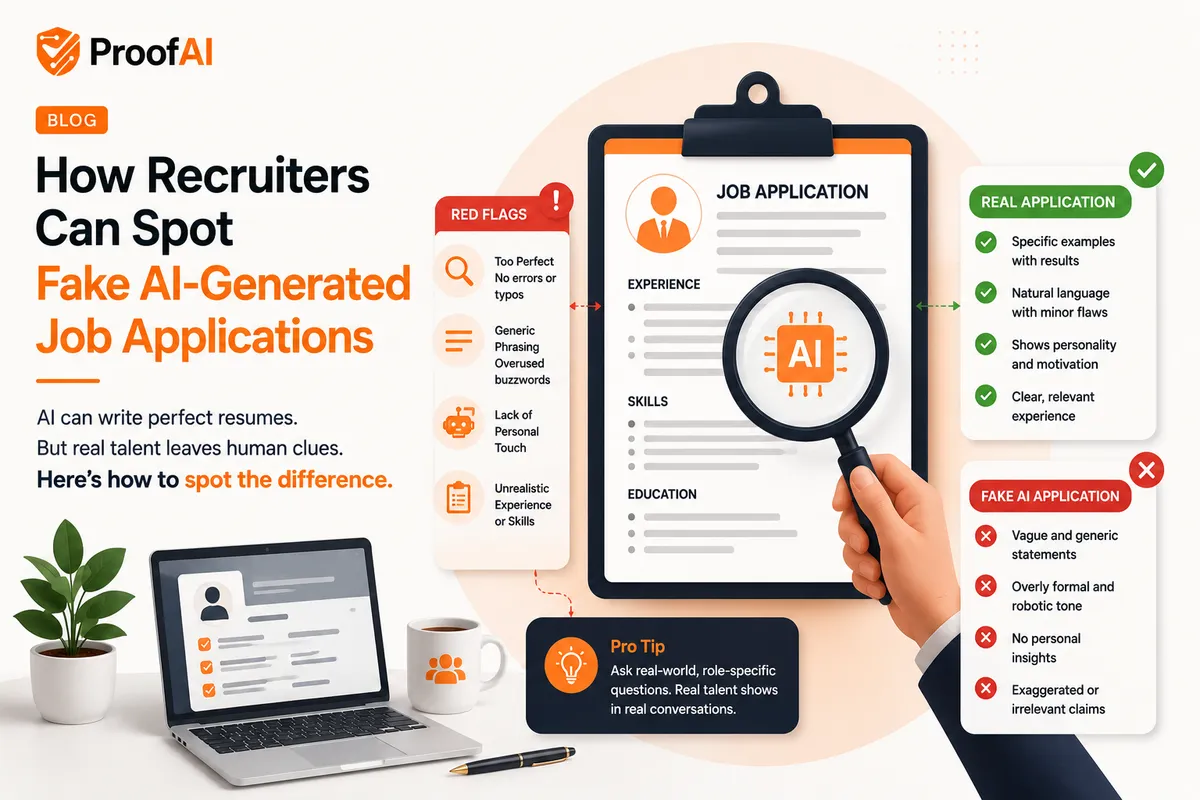
Recruiters who read hundreds of applications start to notice the same patterns. None of them is proof on its own, but together they are what makes a letter feel machine-made:
Try it: use ProofAI's CV AI detector, free for 10 checks a day with no login.
- Polished but empty phrasing. "I am excited to bring my passion for innovation and my proven track record to your dynamic team." Every word is fine; none of it is about this candidate or this job.
- No checkable specifics. No project names, no tools used, no results, no reason for wanting this particular company beyond what is on its careers page.
- The job description, mirrored back. The letter repeats the requirements in the same order and wording, with "I have" in front of each one.
- A tone that does not match the CV. A crisp, formal letter attached to a CV with spelling slips, or the reverse.
- Identical structure across applicants. When five letters for the same role open and close in almost the same way, a template or a chatbot is usually behind them.
Notice what this list has in common: these are weaknesses you would mark down even if a person wrote them. That is the right instinct.
Is using AI for a cover letter dishonest?
Not automatically. Many candidates use AI the way earlier generations used a friend who was good with words, and many employers accept that.
Want to check your own content? Try ProofAI free 10 checks a day, no login needed.
In a TopResume survey of 600 U.S. hiring managers (May 2025), 52% said using AI for proofreading or drafting support is acceptable, although they still expect the final letter to sound human and reflect the candidate. The same survey found that 19.6% would reject a candidate with an AI-generated resume or cover letter, and 25% said cover letters should remain AI-free. Expectations differ, so the useful step for an employer is to say what it expects.
Research on a large freelance platform shows why this matters. When Freelancer.com launched a tool that writes tailored cover letters in one click, the link between how well a letter matched the job and whether the worker got a callback fell by 51%, and employers shifted towards signals that are harder to fake, such as past work history (Cui, Dias and Ye, "Signaling in the Age of AI: Evidence from Cover Letters", arXiv 2025). In plain words: once anyone can produce a well-matched letter, a well-matched letter tells you less.
So the dishonest part is not using AI. It is claiming experience, results or motivation that are not real. That is what your process should be built to catch.
How to check a cover letter for AI
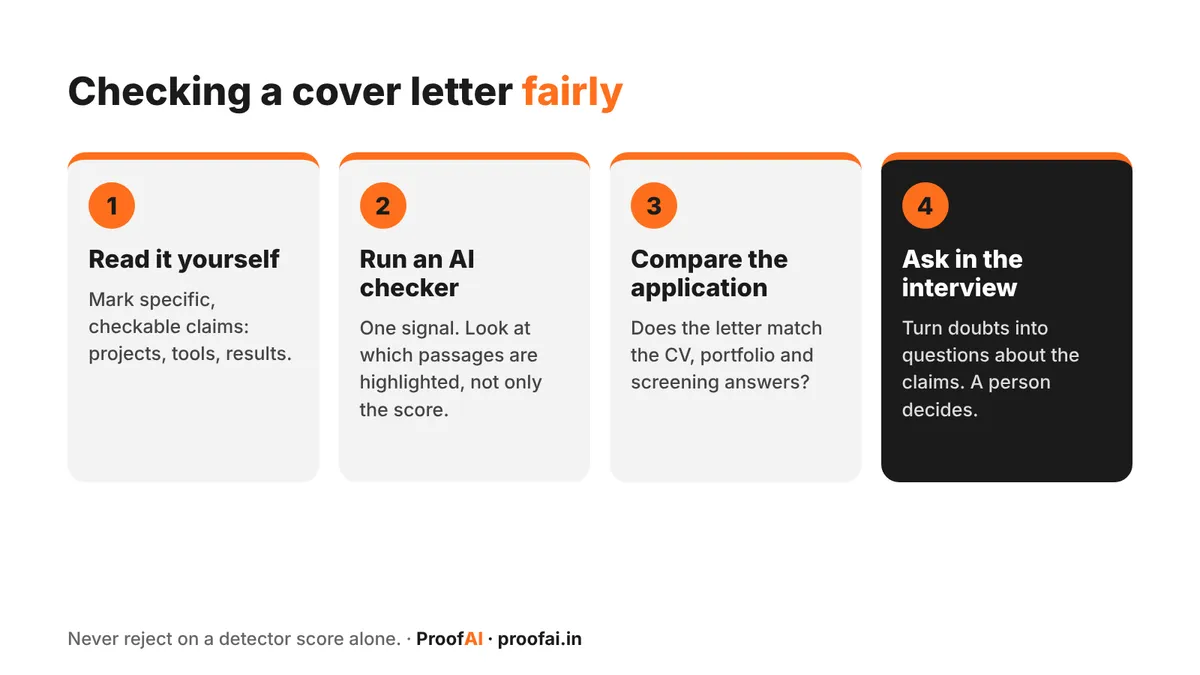
How to review a cover letter fairly: checker as one signal, then specifics, then conversation
Also read: How to Detect AI-Written Resumes and Job Applications
- Read it first, as a recruiter. Mark every sentence that contains a specific, checkable claim: a project, a number, a tool, a team, an outcome. A letter with none is weak regardless of who wrote it.
- Run it through an AI cover letter checker. ProofAI shows an AI probability and highlights the passages that drove it. Paste the text or upload the PDF or Word file; free daily checks work without login. For CVs and other attachments, the document AI detector reads PDF and Word files directly.
- Look at the highlighted passages, not only the score. If the generic opening is flagged but the paragraph about the candidate's actual project is not, that is a very different picture from a fully flagged letter.
- Compare with the rest of the application. Does the letter match the CV, the portfolio, the answers to screening questions?
- Write down what you want to ask. A high score is a reason to probe specifics in the interview, not a reason to reject.
What an AI detector cannot tell you
Cover letters are short and formulaic by nature, which makes them one of the hardest kinds of text for any detector. A candidate who wrote carefully from a template, or who writes in a second language and keeps to safe phrases, can score high. A letter drafted with AI and then rewritten heavily in the candidate's own words can score low. ProofAI, like every detector, can be wrong, so its result should always lead to a human review and never to an automatic rejection.
Better signals than "was this written by AI?"
The question that predicts job performance is whether the candidate can do the work. A few signals help much more than authorship:
- Specific claims you can verify. "I cut our month-end close from eight days to five by rebuilding the reconciliation sheet" can be explored in an interview: how, with whom, what went wrong. A real story survives follow-up questions.
- Fit with the role, in their words. Ask the candidate to explain in two minutes why this job. People who wrote their own letter, with or without help, can usually say the same thing again more loosely.
- Work samples. A short, relevant task tells you more than any letter.
- References and past work. These are exactly the signals employers moved towards in the Freelancer research above (arXiv).
A fair process for AI-assisted applications
Recruiter checklist
- State your AI policy in the job ad or application form: what help is fine (grammar, structure) and what is not (invented experience).
- Judge letters on specific, relevant content first.
- Use an AI checker as one signal, recorded alongside your own notes, never as a pass/fail filter.
- Turn doubts into interview questions about the claims in the letter.
- Apply the same steps to every candidate for the role, so no one is singled out by a score.
- Remember that non-native English writers and neurodivergent candidates may write in ways that look formulaic.
- Keep the final decision with a person who has read the whole application.
For candidates: using AI responsibly
If you are applying for jobs, AI can help you, but it cannot be you.
- Start from your own notes. List three things you did that matter for this role, with real details. Let AI help with structure and grammar, not invent content.
- Rewrite the opening and closing yourself. These are the parts that sound most generic when a tool writes them.
- Never claim what you cannot explain. Every sentence in your letter is a possible interview question.
- Follow the employer's rules. If an application says no AI, respect it; if it asks you to disclose AI use, do.
- Check your file before sending. Running your letter through a checker shows which passages read as generic, so you can rewrite them with your own examples. The goal is a better letter, not a lower score.
FAQ
Can recruiters tell if a cover letter is written by AI? Sometimes they suspect it from generic phrasing, but they cannot know for sure from reading alone. An AI cover letter checker adds a signal; a conversation about the letter's claims adds much more.
Is it okay to use ChatGPT to write a cover letter? Many employers accept AI help with drafting and proofreading, while some want letters to be AI-free (TopResume survey). Follow the employer's stated rules and make sure every claim is true and yours.
How do I check a cover letter for AI? Paste the text or upload the file into an AI cover letter checker, read the highlighted passages, and compare the letter with the CV and the interview. Treat the result as a reason to ask questions.
Should I reject a candidate because the AI checker flagged their cover letter? No. Detectors can be wrong, especially on short, formulaic text. Use the score to decide what to ask in the interview, and decide on the candidate's real skills and experience.
Do AI detectors work on resumes too? Yes, the same approach applies. Our Resume AI Detector explains how to check CVs fairly as part of a wider review.
Conclusion
A cover letter written with AI is not automatically a dishonest one, and a high detector score is not a verdict. Use an AI cover letter checker to see which passages look generic, then focus on what really matters: specific claims the candidate can stand behind in an interview, a fair process applied to everyone, and clear rules about AI use.
Published by
AI tools may assist with drafting; a team member checks and approves every article before it is published. How we write and correct articles.
Popular AI detection tools
Ready to Verify Your Content?
Get weekly insights on AI detection. Start your journey toward digital authenticity with our AI detection tools.