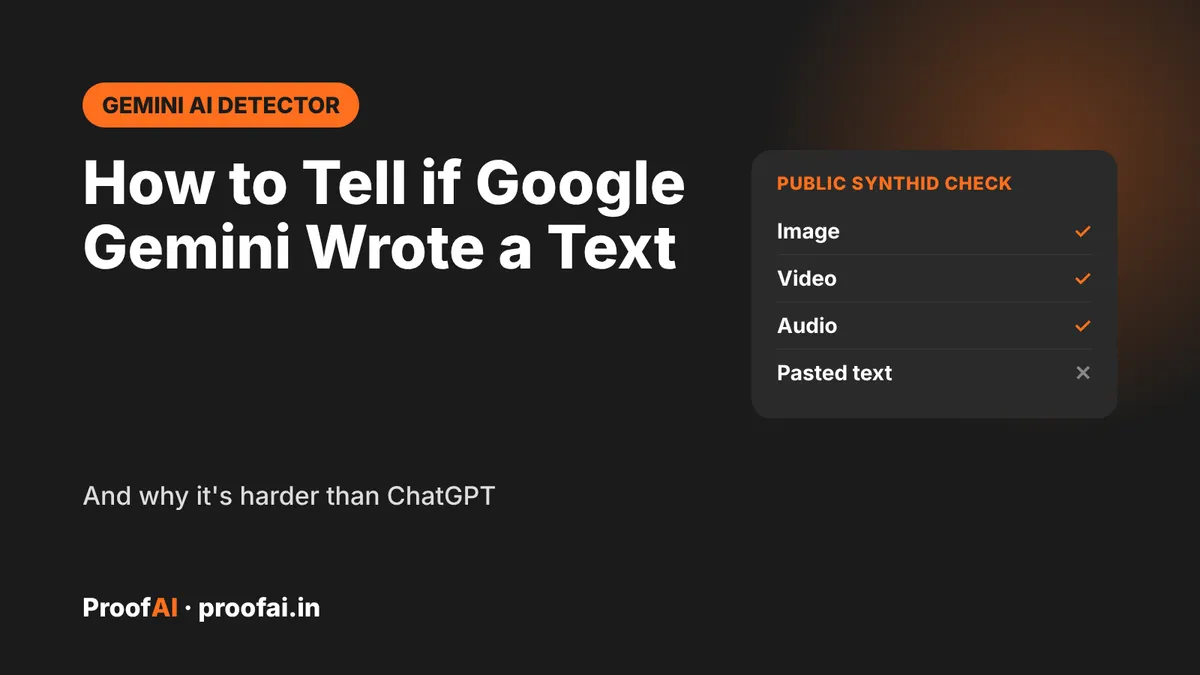
How to Tell if Google Gemini Wrote a Text (and Why It's Harder Than ChatGPT)
Is there a Gemini AI detector? What Google's SynthID can and cannot check, the signs of Gemini text, and how to check a text fairly with an AI detector.
Short answer: there is no public tool from Google that tells you whether a piece of text was written by Gemini. Google watermarks Gemini text with SynthID, but its public checks cover images, video and audio, not pasted text. Asking Gemini "did you write this?" gives a guess, not a check. The practical route is an independent AI detector such as ProofAI's AI text detector, read alongside drafts and a conversation with the writer.
This guide explains what Google offers, why Gemini text is harder to pin down than many people expect, and how teachers, recruiters and editors can check a text fairly.
Try it: use ProofAI's free ChatGPT checker, free for 10 checks a day with no login.
Is there an official Gemini AI detector?
Not for text, for the public. Here is what Google has actually released.
SynthID watermarks Gemini text. Google DeepMind says it has expanded SynthID to watermark and identify text generated by the Gemini app and web experience. The watermark works by slightly adjusting the probability of the words the model picks as it writes, which leaves a statistical pattern a reader cannot see (Google DeepMind).
The public checks are for media, not text. On the same page, Google says the SynthID Detector portal is open to everyone for checking whether an image, video or audio file was made with AI from Google or its partners, and that you can upload an image, video or audio clip to the Gemini app and ask whether Google AI created it (Google DeepMind). When Google introduced image verification in the Gemini app, the feature was for images (Google blog).
Text checking was limited to testers. When Google first announced the SynthID Detector portal, it listed text among the content it could scan, but access was for early testers, with a waitlist for journalists, media professionals and researchers (Google blog).
So if a website calls itself an "official Gemini checker", be careful: it is not a Google product.
What SynthID Text is, and what it is not
Google DeepMind open-sourced SynthID Text in 2024 so that other developers can watermark text from their own language models and detect it later (MIT Technology Review). A production implementation is available in Hugging Face Transformers (Hugging Face).
Want to check your own content? Try ProofAI free 10 checks a day, no login needed.
That is a tool for model builders, not a checker for teachers. A watermark detector can only recognise text from a model that applied that watermark, and MIT Technology Review noted that SynthID text detection worked only on content generated by Google's models (MIT Technology Review). It says nothing about text from ChatGPT, Claude or any other model.
Google is also open about the limits. Its developer documentation says the watermark is less effective on factual responses, and that detector confidence can drop sharply when AI text is thoroughly rewritten or translated into another language (Google AI for Developers). In practice, most texts you receive have been copied, edited and pasted by a person, so a missing watermark proves little.
Why Gemini text is harder to spot than ChatGPT text
People have spent years learning the "tells" of ChatGPT. Gemini is less familiar, and a few things make it harder:
Also read: SynthID Explained: How to Check if an Image Was Made With Google AI
- It may not come from a chat window. AI help is increasingly built into writing tools, so a text may be drafted inside a document or email rather than a chatbot, with no chat history to show.
- The style changes. Models are updated and new versions write differently, so any list of "Gemini phrases" goes out of date.
- Writers edit. A student who drafts with Gemini and rewrites half of it produces a mix. No checker can cleanly label that as one or the other.
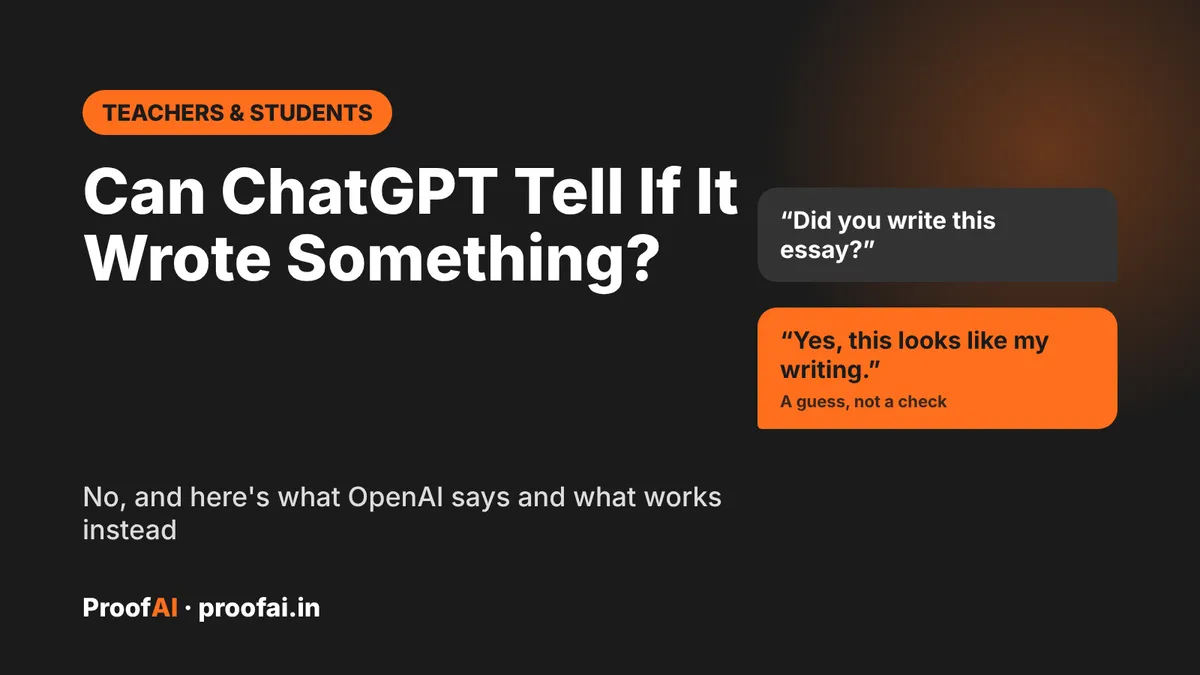
There is also no "ask the chatbot" shortcut. As we explain in Can ChatGPT tell if it wrote something?, a chatbot asked whether it wrote a text predicts a plausible answer rather than checking a record. The same applies to Gemini.
The common signs of AI writing (and why they are unreliable)
These patterns show up in text from every large model, not only Gemini:
- Smooth, even paragraphs with little variation in length or rhythm.
- Confident, general statements with few specific names, dates, places or personal details.
- Neat summaries at the end of every section, and lists of three.
- References that look real but cannot be found.
Treat these as reasons to look closer, never as proof. Careful human writers, especially students who follow a template, write this way too. Research covered by Stanford HAI found that AI detectors flagged essays by non-native English writers as AI-generated far more often than essays by native speakers (Stanford HAI). That is a serious fairness issue for anyone who writes in English as a second language.
How AI detectors approach Gemini text
Independent detectors do not need a watermark. They are trained on large amounts of human-written and AI-generated text and learn the statistical patterns that separate them, then score a new text and highlight the passages that drove the score.
ProofAI's AI text detector is designed to detect text from widely used models such as ChatGPT, Gemini and Claude, and it shows which passages look most AI-written. If you specifically suspect ChatGPT, the ChatGPT checker works the same way. Like every detector, it can be wrong, especially on short, formulaic or heavily edited text. Even OpenAI shut down its own AI text classifier in 2023 because of its low accuracy (Business Today), which is a useful reminder that detection is about probability, not proof.
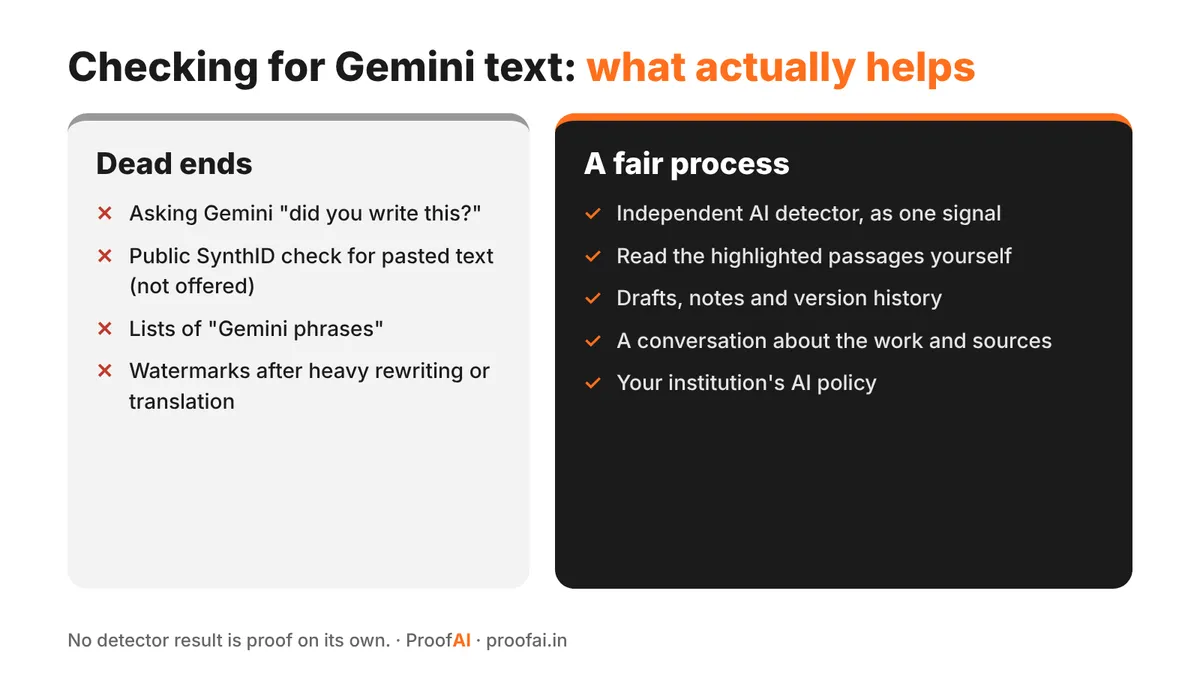
How to check if Gemini wrote a text: what Google offers vs a fair checking process
A fair way to check a text you suspect
For teachers and reviewers
- Run the text through an independent detector and read the highlighted passages yourself.
- Ask for the process. Drafts, notes and version history show how a text grew.
- Talk to the writer. Someone who wrote an essay or report can usually explain the argument, the sources and the choices they made.
- Compare with earlier work, and treat a change in style as a reason for a conversation, not a verdict.
- Follow your institution's AI policy and record what you checked and why.
For students and job seekers
- Keep your drafts and version history, and save your chats if you used AI where it was allowed.
- Check your own text before you submit with the AI text detector and rewrite generic passages with your own examples.
- Disclose AI use where your course or employer asks you to.
FAQ
Is there a Gemini AI detector from Google? Not for text, for the public. Google watermarks Gemini text with SynthID, but its public SynthID checks are for images, video and audio (Google DeepMind).
Can I ask Gemini if it wrote a text? You can ask, but the answer is a guess. A chatbot predicts a plausible reply instead of checking a record of what it wrote for other people. Use an independent detector and look at drafts instead.
Can SynthID detect ChatGPT or Claude text? No. A watermark detector only recognises text from models that applied that watermark (Google AI for Developers).
Can ProofAI detect Gemini text? ProofAI's AI text detector is designed to detect text from widely used models including Gemini, ChatGPT and Claude. Treat the result as one signal and review it together with the writer's drafts.
What should I do if I am wrongly accused of using Gemini? Stay calm and share your drafts, notes and version history. Offer to talk through your work and sources, and point out that detector results and chatbot answers are not proof on their own.
Conclusion
You cannot paste a text into a Google tool and get a yes or no on Gemini today. SynthID helps Google mark its own output, but it does not cover text you receive from anyone else. Use an independent detector as a starting point, then rely on drafts, conversation and clear AI rules to reach a fair decision.
Published by
AI tools may assist with drafting; a team member checks and approves every article before it is published. How we write and correct articles.
Popular AI detection tools
Ready to Verify Your Content?
Get weekly insights on AI detection. Start your journey toward digital authenticity with our AI detection tools.