Is ZeroGPT Accurate? What Tests Show and How to Check Fairly
Is ZeroGPT accurate? What ZeroGPT claims, what peer-reviewed studies and hands-on tests found, why false positives happen and how to check a text fairly.
Short answer: ZeroGPT can catch clearly AI-written text, but independent tests show it is less accurate than its own claims, and it does flag human writing as AI. A peer-reviewed 2025 study found it wrong on more than a third of the texts it tested (PeerJ Computer Science). Use its score as one signal, check the same text with a second tool such as the free AI detector, and never treat any score as proof.
Below: what ZeroGPT says about itself, what the studies found, why false positives happen, and a fair way to check a text when the result matters.
Try it: use ProofAI's free AI checker, free for 10 checks a day with no login.
What ZeroGPT claims
ZeroGPT is one of the best-known free AI detectors. You paste up to 15,000 characters on its homepage, and it highlights the sentences it thinks are AI-written, with a gauge showing the percentage of AI in the text (ZeroGPT).
Its homepage advertises 98.4% detection accuracy, a false positive rate under 1% and coverage of 35+ language model families, using what it calls DeepAnalyse technology (ZeroGPT). These are ZeroGPT's own figures, measured on its own data. We could not find a published test set or method behind them.
ZeroGPT's FAQ is honest about one limit: it says highly polished, formulaic or low-entropy human writing "can resemble AI", recommends checking 150-200+ words, and asks users to run OCR first on scanned PDFs (ZeroGPT FAQ).
What independent tests show
A peer-reviewed study (2025)
The most detailed recent test is a study in PeerJ Computer Science. It used 72 abstracts from journal articles published before ChatGPT, plus AI-written versions from ChatGPT o1 and Gemini 2.0 Pro, and ran them through GPTZero, ZeroGPT and DetectGPT. ZeroGPT reached 64.35% overall accuracy, with a false positive rate of 16.67% on the human-written abstracts and a false negative rate of 45.14%, meaning it missed many AI-written ones (Pratama, PeerJ Computer Science, 2025).
Want to check your own content? Try ProofAI free 10 checks a day, no login needed.
In plain words: in that test, about one in six human-written abstracts was labelled AI, and a large share of AI-written abstracts passed as human. The same study found that detectors treated writing by non-native English authors and some academic disciplines differently, which is a fairness problem for any tool.
A study of 14 detectors (2023)
An international group of academic-integrity researchers tested 14 detection tools, ZeroGPT among them, and concluded that the tools were "neither accurate nor reliable": all scored below 80% accuracy on their test set (Weber-Wulff et al., 2023). They also noted that ZeroGPT reported "AI-generated" on two runs of the same test case, but with different percentages. The tools in that study were tested in 2023, and ZeroGPT may have changed since.
Non-native English writers (2023)
A Stanford study ran 91 TOEFL essays written by non-native English speakers through seven detectors, including ZeroGPT. On average, the detectors flagged 61.22% of these human-written essays as AI-generated, while essays by US eighth-graders were classified almost perfectly (Liang et al., 2023). The average covers all seven tools, not ZeroGPT alone, but for students in India who write in English as a second language, this is the risk to keep in mind.
The US Constitution example
In 2023, Ars Technica fed part of the US Constitution into several detectors. ZeroGPT returned "Your text is AI/GPT Generated." (Ars Technica). The article explains why: famous, widely copied text is so familiar to language models that it looks "predictable", which is what many detectors read as a sign of AI. This was a 2023 test, and current versions may behave differently, but the reason it happened still applies to formulaic writing today.
Also read: How to Check if a PDF Was Written by AI (Step by Step)
A journalist's hands-on test (2025)
Not every test is negative. ZDNet's David Gewirtz runs five texts (two human, three by ChatGPT) through a set of detectors regularly. In October 2025, ZeroGPT classified all five correctly, after getting four of five right in an earlier round (ZDNet). Five texts is far too few to measure accuracy, but it shows ZeroGPT handles clear-cut cases well and has improved.
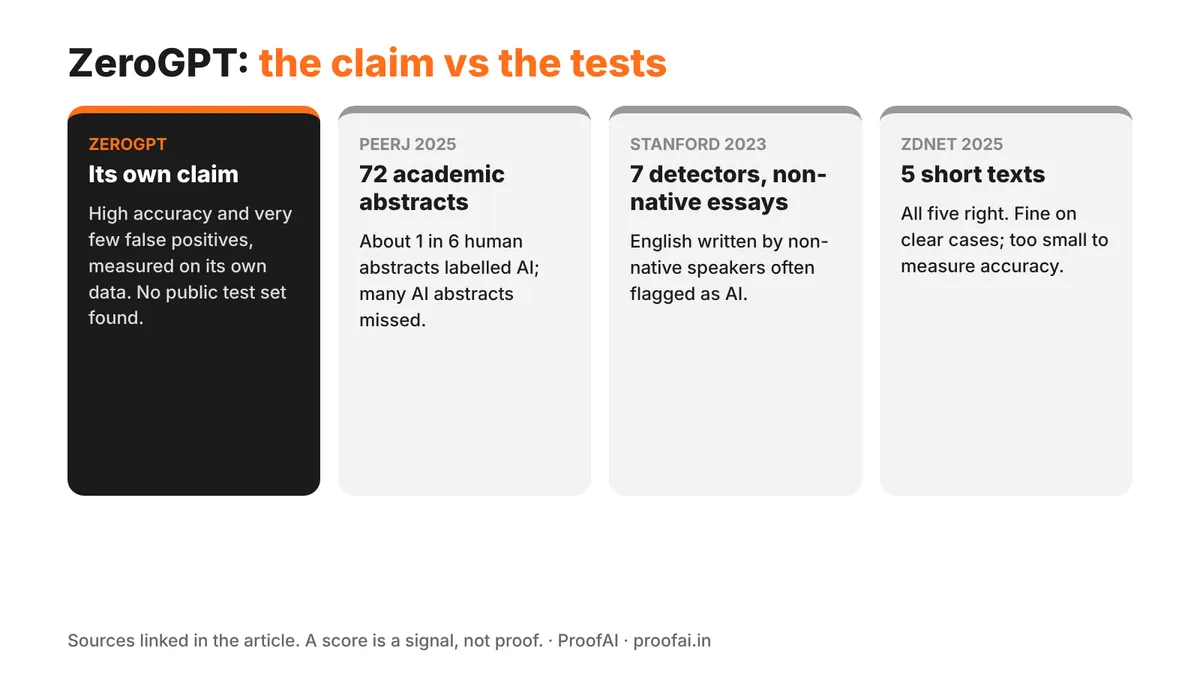
ZeroGPT's claims next to what independent tests found
Claims and tests side by side
| Source | What was tested | Main finding |
|---|---|---|
| ZeroGPT homepage | ZeroGPT's own data | Claims high accuracy and a very low false positive rate (ZeroGPT) |
| Pratama, PeerJ 2025 | 72 human abstracts plus AI versions | About one in six human abstracts flagged as AI (PeerJ) |
| Weber-Wulff et al. 2023 | 14 tools, 54 test cases | No tool reliable; same text gave different ZeroGPT percentages (arXiv) |
| Liang et al. 2023 | 7 tools, 91 non-native essays | Non-native English writing often flagged as AI (arXiv) |
| ZDNet, Oct 2025 | 5 texts | All five classified correctly (ZDNet) |
The pattern: ZeroGPT does well on short, clear tests, and less well on larger, harder test sets, especially academic writing and non-native English. That pattern is not unique to ZeroGPT. It shows up for most detectors.
Why ZeroGPT gives false positives
A false positive is human writing labelled as AI. It happens with every detector, for the same few reasons:
- Predictable text looks like AI. Detectors look for word choices a language model would find likely. Formal, formulaic writing, standard definitions and famous texts are predictable by nature.
- Second-language English is often simpler. A smaller vocabulary and simpler sentences make text more predictable, which is why non-native writers are flagged more often (Liang et al., 2023).
- Short text gives little evidence. A paragraph or two is not enough for any tool to judge reliably. ZeroGPT itself recommends at least 150-200 words (ZeroGPT FAQ).
- Grammar and editing tools. Text polished with a grammar checker or rewriting tool can pick up the smooth, even style detectors associate with AI.
- Scores move. The same text can get a different percentage on another day or after a model update (Weber-Wulff et al., 2023).
How to check a text fairly
If a ZeroGPT result will affect a grade, a job or a publication, use this checklist:
- Check at least a few hundred words, and the whole document if you can, not one paragraph.
- Run a second detector. If two tools disagree strongly, that disagreement is useful information.
- Read the highlighted sentences. Are they references, definitions and standard phrases, or the writer's own argument?
- Ask for drafts and version history. Google Docs and Word keep it, and it shows how the text grew.
- Compare with earlier work by the same writer.
- Talk to the writer about their sources and choices before reaching any conclusion.
If you are a student who was flagged, keep calm, gather your drafts and notes, and ask for a conversation. The studies above are worth pointing to: they show that human writing is flagged by detectors more often than many people expect.
Checking with ProofAI
ProofAI is an AI detector made in India, priced in rupees. Paste text into the AI text detector or upload a PDF, DOCX, DOC or TXT file up to 25 MB in the document checker, and you get an AI probability with the passages that drove it. It is free for 10 checks a day without logging in and 25 with a free account; it also checks images, and video detection is coming soon.
ProofAI is not immune to the problems above. Like every detector it can be wrong, especially on short, formulaic or heavily edited text, so use it as a second opinion, not a verdict. For a fuller comparison of plans and features, see ZeroGPT alternative, and for how we test our own detector, see the accuracy page.
FAQ
Is ZeroGPT accurate? Partly. It handles clear-cut AI text well in small tests, but a 2025 peer-reviewed study found it correct on fewer than two in three texts and wrong about one in six human abstracts (PeerJ). Its own accuracy claims are not backed by a published test set we could find.
Does ZeroGPT give false positives? Yes. Independent studies found it labelling human-written text as AI, especially formal academic writing and English written by non-native speakers (Liang et al., 2023). ZeroGPT's own FAQ says polished, formulaic writing can resemble AI.
Did ZeroGPT really say the US Constitution was written by AI? In a 2023 test by Ars Technica, ZeroGPT returned "Your text is AI/GPT Generated" for part of the US Constitution (Ars Technica). Current versions may give a different result.
Can a university rely on ZeroGPT to prove AI use? No detector result is proof on its own. Researchers who tested 14 tools concluded they were not reliable enough to decide cases alone (Weber-Wulff et al., 2023). Use a score as a reason to look at drafts and talk to the student.
Why does ZeroGPT give a different score each time? Detectors are updated, and small changes in the text you paste (headers, references, line breaks) change the input. Researchers also saw ZeroGPT give different percentages for the same test case on two runs (Weber-Wulff et al., 2023).
Conclusion
ZeroGPT is a useful free first check, and it has improved, but the published tests do not support treating its score as a verdict, and its false positives fall hardest on formal and second-language writing. Check enough text, compare with a second detector, and let drafts and a conversation with the writer decide.
Published by
AI tools may assist with drafting; a team member checks and approves every article before it is published. How we write and correct articles.
Popular AI detection tools
Ready to Verify Your Content?
Get weekly insights on AI detection. Start your journey toward digital authenticity with our AI detection tools.