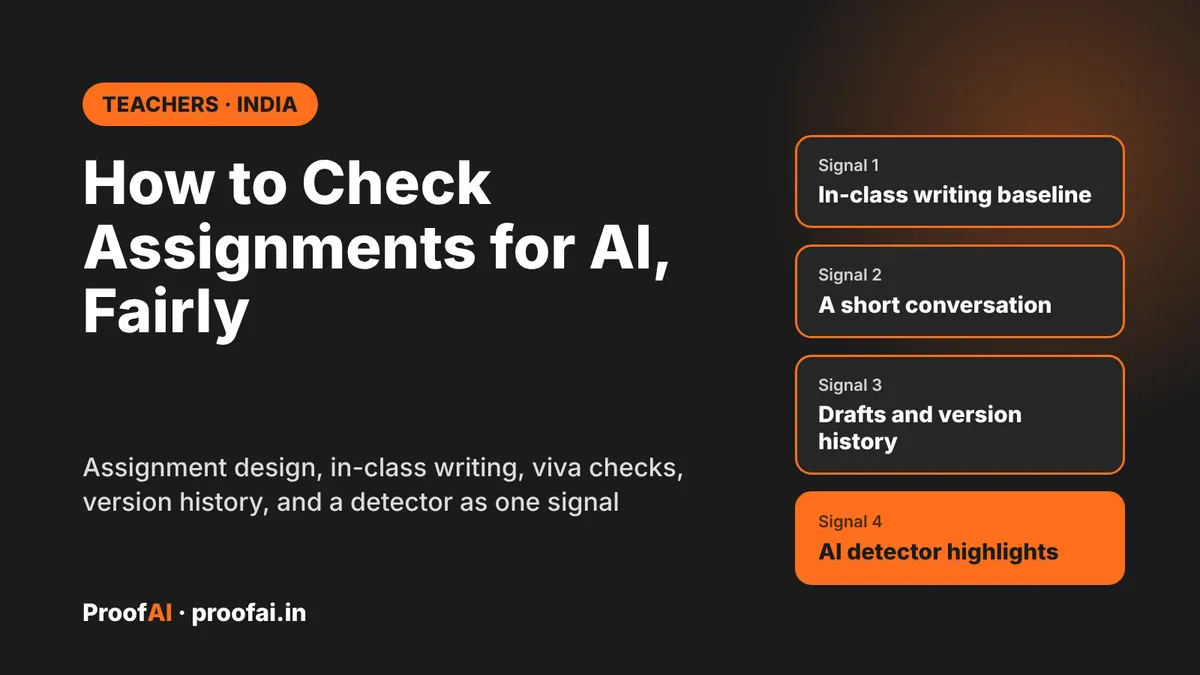
How Teachers in India Can Check Assignments for AI (Fairly)
How teachers in India can check assignments for AI fairly - assignment design, in-class writing, viva checks, version history, and using an AI detector as one signal.
Short answer: combine several signals instead of trusting one score. Set clear AI rules, design assignments that need the student's own context, collect some writing in class, ask students to explain their work in a short conversation, look at version history, and use an AI detector for India only as one signal among these. Never accuse a student on a detector result alone; even Turnitin says its AI score should not be the sole basis for action (Turnitin).
This guide is for school and college teachers in India. It covers practical classroom methods, how to read an AI detector result, why non-native English writers are at risk of false flags, and a fair process to follow before any accusation.
Try it: use ProofAI's ChatGPT checker, free for 10 checks a day with no login.
Start with clear rules
Students cannot follow a rule they have not been given. In most Indian colleges, the rule for coursework comes from the institution or the teacher, not from the UGC: the UGC's plagiarism regulations cover theses, dissertations and research papers and expressly exclude assignments, term papers, course work and essays (UGC Regulations, 2018, clause 2). Institutions differ. At ISB individual faculty decide whether AI is permitted, restricted or banned for each course or task, and at IISER Pune AI is allowed unless a teacher or supervisor rules it out in writing (Elets / Indian Express).
For each assignment, write one or two lines that say what is allowed (for example grammar help or brainstorming), what is not (for example writing the answer), and how students should disclose AI use. IIT Delhi's guidelines suggest disclosure in captions, footnotes or a statement within the work (PTI via Dinamalar), which is easy to adapt for school and college tasks.
Our guide Do Indian universities check for AI? summarises what institutions have published.
Design assignments AI cannot do alone
The most effective check is an assignment where AI output is obviously not enough:
Want to check your own content? Try ProofAI free 10 checks a day, no login needed.
- Local and personal context. Ask students to use data from their town, an interview with a family member, a visit, or a discussion from your own class. A chatbot does not know what was said in your classroom last Tuesday.
- Process, not just product. Collect an outline, a first draft and a final version. Changes between stages show thinking.
- Applied judgement. Indian institutions are moving this way: ISB assignments now weigh problem framing, synthesis and decision-making, backed by in-person discussions and case defences (Elets / Indian Express).
- Separate the skill you are grading. In one IISER Pune bioinformatics course, students could use AI to write code for assignments but had to solve similar problems unaided in the exam (Elets / Indian Express).
- Real references. Ask for page numbers or a photo of the source used. AI tools invent citations, and IISER Pune evaluators checked AI-allowed work for hallucinated references (same report).
Build a baseline with in-class writing
A short piece of writing done in class, by hand or on a locked-down device, shows you how each student writes: vocabulary, sentence length, typical mistakes, how they structure an argument. Keep these samples. When a take-home assignment looks very different, you have something concrete to compare it with, which is more reliable than any general impression of "AI style".
Exams remain the clearest controlled setting. CBSE, for example, said in 2023 that using ChatGPT in Class 10 and 12 board exams would count as unfair means (Deccan Herald / PTI).
Ask students to explain their work
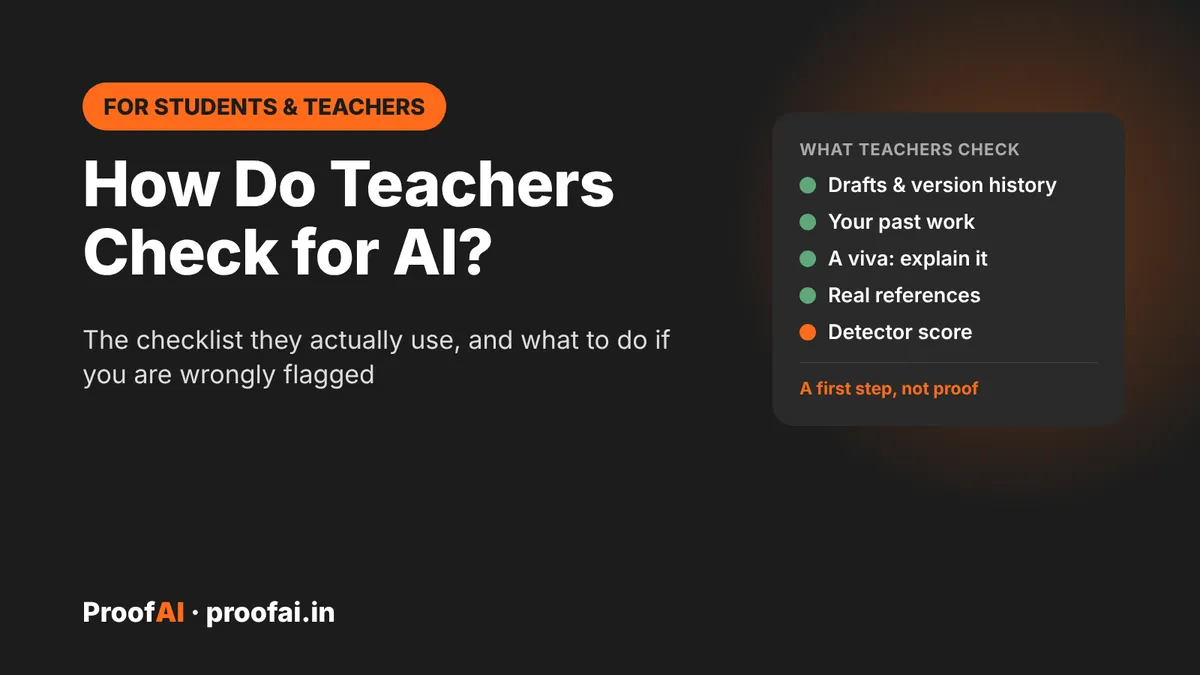
A short conversation, or a brief viva, is often the fairest check. Ask the student to:
- summarise their main argument without looking at the paper;
- explain why they chose a particular source or example;
- define a technical term they used;
- say what they would change with more time.
A student who wrote the work can usually answer easily, even if their spoken English is less polished than their writing. Keep it a conversation, not an interrogation, and make notes.
Also read: India's AI Labelling Rules 2026: What the IT Rules Require
Look at version history
If students write in Google Docs, the version history shows how a document grew over time. Writing that builds up over several sessions, with edits and deletions, looks very different from one large paste. Version history is evidence of process, not proof either way: some students draft offline or in a notebook and type up at the end. Ask before you assume.
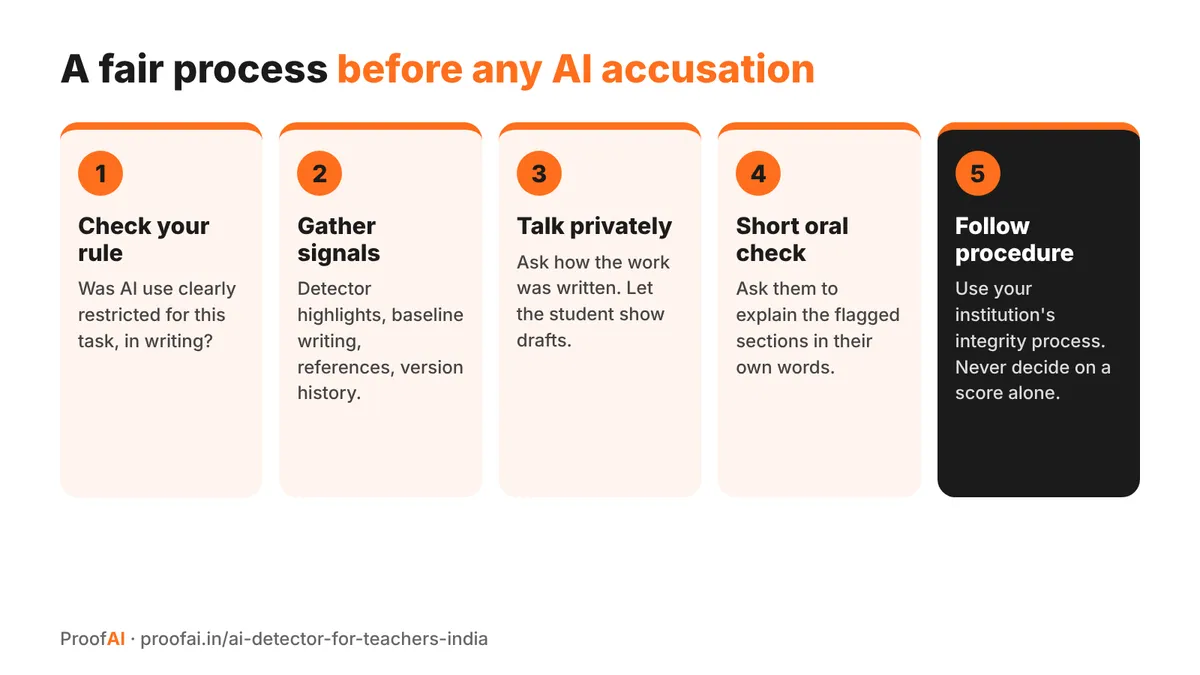
A fair process before any AI accusation: set rules, gather several signals, talk to the student, review drafts, and decide by your institution's procedure
Use an AI detector as one signal
An AI detector estimates how likely it is that text was generated by a model. It is useful for deciding where to look, not for deciding what happened. ProofAI's AI detector for teachers in India shows an AI probability and the sentences that drove it, and it reads PDF and Word files directly, with free checks every day.
Read results with care:
- Look at the highlighted passages. A high score driven by a generic introduction means something different from one driven by the analysis.
- Compare with the student's baseline. Does the flagged text differ from their in-class writing?
- Be careful with short texts. Turnitin notes that short documents tend to get "all or nothing" predictions (Turnitin FAQ).
- Remember institutions have doubts too. Vanderbilt University disabled Turnitin's AI detector in 2023 after testing it, citing concerns about false positives and bias against non-native English speakers (Vanderbilt).
The non-native English problem
This matters in any Indian classroom where English is not every student's first language. Stanford researchers tested seven widely used AI detectors and found they classified 61.22% of TOEFL essays written by non-native English students as AI-generated, while being "near-perfect" on essays by US eighth-graders (Stanford HAI).
The reason, according to the same study, is that detectors rely on how predictable the wording is, and writers with a smaller vocabulary and simpler sentence structures produce more predictable text (Stanford HAI). Formulaic writing can be affected too: Turnitin lists text with little structural variation among the things that can trigger false positives (Turnitin FAQ). A high score on such writing calls for a conversation, never a penalty.
A fair process before any accusation
| Step | What to do |
|---|---|
| 1. Check your rule | Was AI use clearly restricted for this task, in writing? If not, this is a teaching moment, not misconduct. |
| 2. Gather several signals | Detector highlights, baseline comparison, references, version history. One signal is not enough. |
| 3. Talk privately | Ask how the work was written. Give the student a chance to show drafts and notes. |
| 4. Short oral check | Ask them to explain the flagged sections in their own words. |
| 5. Follow the procedure | Use your school's or college's academic integrity process and keep notes of each step. |
For theses and research work in higher education, the UGC regulations require integrity panels that follow "the principles of natural justice", with penalties only after misconduct is established and appeals are exhausted (UGC Regulations, 2018, clauses 10-12). The same standard is a good guide for any classroom.
What AI detectors cannot do
No AI detector, ProofAI included, can prove who wrote a text. Detectors can flag human writing and miss edited AI text. That is why the score should start a review by a person, and why the methods above (clear rules, good assignment design, baselines and conversation) do most of the work. For more on why human writing gets flagged, see AI detector false positives.
FAQ
Can teachers in India use AI detectors on student work? Yes, unless your institution says otherwise. Use the result as one signal and tell students in advance how their work will be checked.
What AI detector score is "too high"? There is no safe or failing number. Turnitin does not publish one and leaves the decision to the educator and the institution's policy (Turnitin FAQ), and a score only tells you where to look; the student's drafts and explanation tell you what happened.
Is it fair to ask a student to explain their assignment orally? Yes, if you do it consistently and kindly. A short conversation about choices and sources is a normal part of teaching and the fairest check available.
What should I do if a student's essay is flagged but I have no other evidence? Do not penalise. Talk to the student, look at drafts, and treat it as a chance to explain your AI rules. A score alone is not evidence of misconduct.
Does CBSE have rules on AI in homework? We found no CBSE rule on AI in homework. CBSE said in 2023 that using ChatGPT in board exams counts as unfair means (Deccan Herald / PTI); for homework, follow your school's policy.
Conclusion
Checking for AI fairly is mostly good teaching: clear rules, assignments rooted in your classroom, a writing baseline and a conversation with the student. An AI detector helps you decide where to look. The decision should rest on evidence a student can see and answer.
Published by
AI tools may assist with drafting; a team member checks and approves every article before it is published. How we write and correct articles.
Popular AI detection tools
Ready to Verify Your Content?
Get weekly insights on AI detection. Start your journey toward digital authenticity with our AI detection tools.