How to Tell if Claude Wrote a Text: Signs, Limits and Fair Checks
Is there a Claude AI detector? What Anthropic's planned watermark can and cannot show, whether Turnitin detects Claude, and how to check a text fairly.
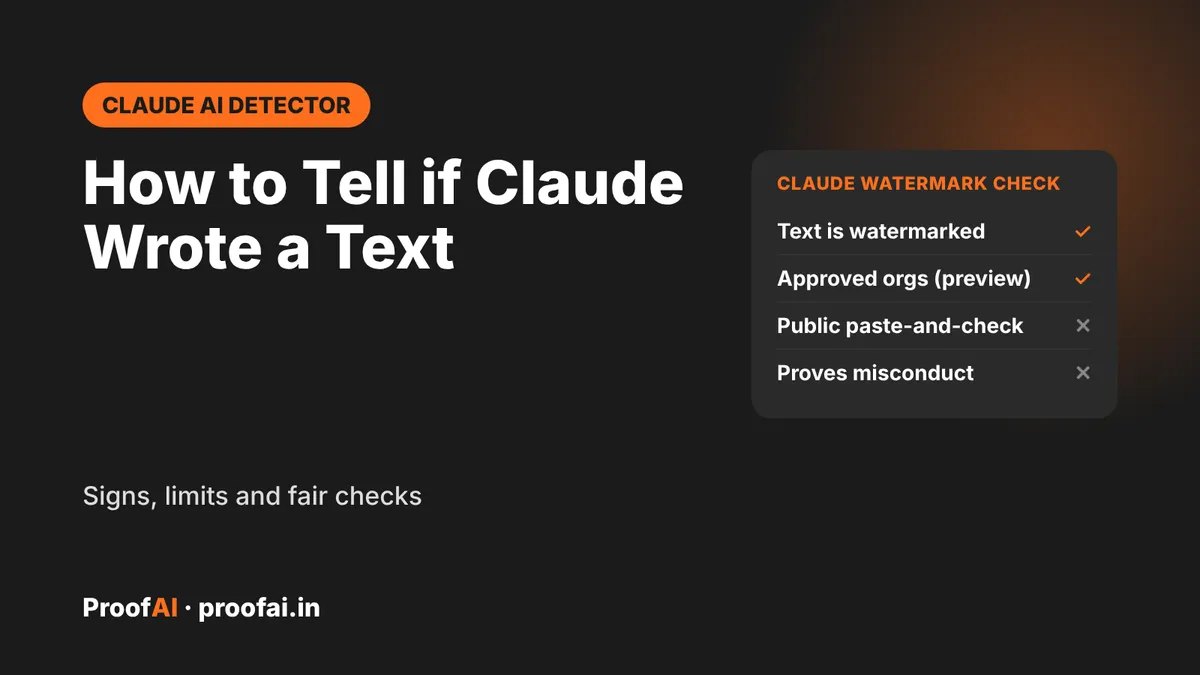
Short answer: you cannot paste a text into a public Anthropic tool and get a yes or no on Claude. Anthropic says future Claude models will watermark their text, but its detection API is in private preview for eligible organisations, not open to teachers or recruiters at large. Turnitin lists several Claude models among those its detector covers. For everyone else, the practical route is an independent checker such as ProofAI's AI text detector, read alongside drafts, version history and a conversation with the writer.
This guide explains what Anthropic has actually released, what Turnitin says about Claude, which "Claude signs" are worth noticing, and how to check a text without accusing an honest writer.
Try it: use ProofAI's AI detector tool, free for 10 checks a day with no login.
Does Anthropic offer a Claude AI detector?
Not one the public can use today. Here is the current position, from Anthropic's own explanation of its watermark (Anthropic).
Future Claude models add a watermark. Anthropic says future Claude models generate text containing a watermark, to comply with the EU AI Act. The method is a version of Google DeepMind's SynthID-Text approach: when the model chooses between equally good words, the choice is settled by a secret key instead of a plain random number. Nothing is added to the text, there are no hidden characters, and readers cannot see any difference.
Checking it needs Anthropic's key. Anthropic says it is releasing a detection API in private preview, available to eligible organisations as required under EU law, such as regulators, media, fact-checkers, independent researchers and educational organisations, and to enterprises that must verify watermarking for their own compliance. It plans to expand access over time (Anthropic).
Files are labelled differently. For images and other supported files, Claude attaches a C2PA content credential in the file's metadata saying the file was made or processed with Claude (Anthropic).
So if a website calls itself the "official Claude detector", it is not an Anthropic product.
What the Claude watermark can and cannot prove
Anthropic is unusually open about the limits, and they matter for anyone hoping the watermark will settle a dispute (Anthropic):
Want to check your own content? Try ProofAI free 10 checks a day, no login needed.
- It only answers one question: how likely it is that Claude was involved. It cannot confirm that a text was human-written, and it cannot tell whether a different AI wrote it.
- It cannot separate writing from editing. Anthropic says a watermark cannot distinguish "Claude wrote this" from "Claude heavily edited this".
- Short and factual text carries little signal. Detection does not work well on small samples, and the watermark is sparse on factual passages and code, where there is only one right word.
- Proofreading leaves almost nothing. When Claude only fixes grammar in a person's text, nearly all the words are still the person's, so there may be too little to detect.
- Translations are marked, because Claude chooses every word of a translation.
- Older models are still being added. Anthropic says EU law gives a transition period for models launched before the watermark requirement and that coverage for them will roll out over the coming months.
- It identifies no one. The watermark carries no information about the user, their organisation or their chats.
In short, even a positive watermark result is a probability about Claude's involvement, not a finding about misconduct.
Can Turnitin detect Claude?
Turnitin says its English AI writing detection model can detect content from a list of named models, and that list includes Claude-3-Haiku, Claude Sonnet 3.5 and 3.7, Claude Haiku 4.5, Claude Sonnet 4.5 and 4.6, and Claude Opus 4.6 (Turnitin). Turnitin does not need Anthropic's watermark key; its model learns statistical patterns from AI-generated and human academic writing.
A few conditions from the same Turnitin FAQ are worth knowing (Turnitin):
- An English submission needs at least 300 words of prose in long-form writing to get an AI score (Turnitin).
- Scores from 1% to 19% are not shown as a number; the report displays an asterisk instead, to reduce false positives (Turnitin).
- Turnitin says the percentage should not be the sole basis for action, and that it does not make a determination of misconduct.
Our guide to Turnitin's AI score explains how to read the report itself.
Also read: Signs Content Was Written by ChatGPT (and Their Limits)
Signs that a text may come from Claude (and why they are weak evidence)
Anthropic itself gives two examples of the "tells" that AI detection software looks for: AI models appear fond of the construction "this isn't X, it's Y", and use the word "quietly" more than you might expect (Anthropic). Other patterns readers often notice in long answers from Claude and similar models:
- Long, carefully hedged explanations that weigh both sides before concluding.
- Tidy headings, bullet lists and a closing summary, even in text that did not need them.
- Polished, general sentences with few personal details, dates or local specifics.
None of this proves anything. Many careful writers hedge, structure their work and summarise, and a single fashionable phrase is not a fingerprint. Writing style also shifts with each model version, so any list of "Claude phrases" ages quickly.
Context matters too. Anthropic says India is the second-largest market for Claude.ai and that nearly half of Claude usage in India is computer and mathematical work (Anthropic), so many people use Claude for coding and technical help rather than for writing essays. Anthropic's Claude for Education also includes a Learning mode that guides students' reasoning instead of handing them answers (Anthropic). A student who used Claude this way, where it was allowed, has done nothing wrong.
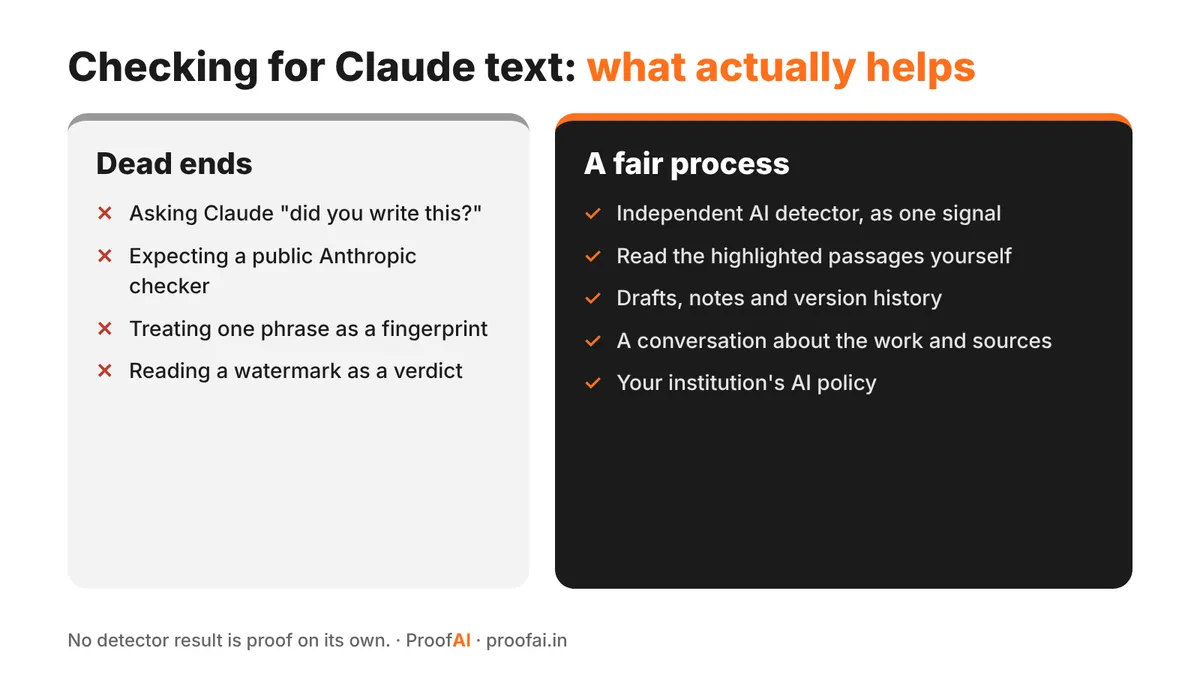
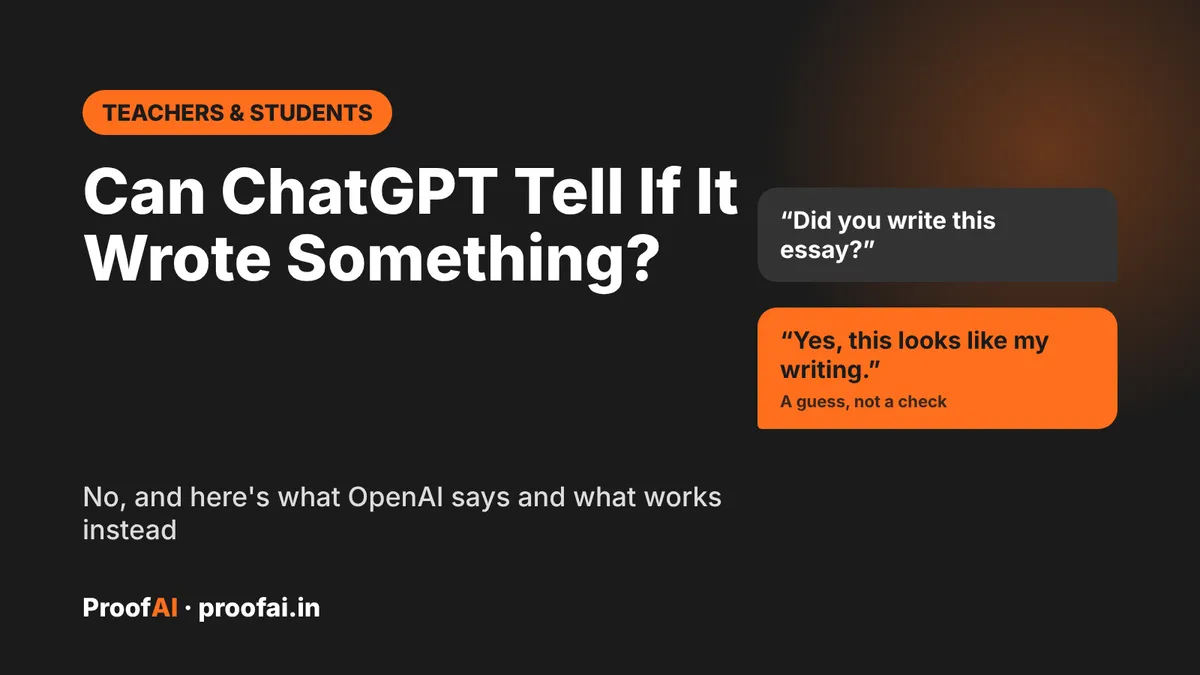
And asking Claude "did you write this?" will not help. As we explain in Can ChatGPT tell if it wrote something?, a chatbot predicts a plausible answer rather than checking a record, and Claude is no different.
How ProofAI approaches Claude text
ProofAI's AI text detector is designed to detect text from widely used models, including Claude, ChatGPT and Gemini. It does not rely on any company's watermark: it looks for the statistical patterns of AI writing and highlights the passages that drove the result, so you can read them yourself. For essays or reports that arrive as files, the PDF and Word checker does the same on the document.
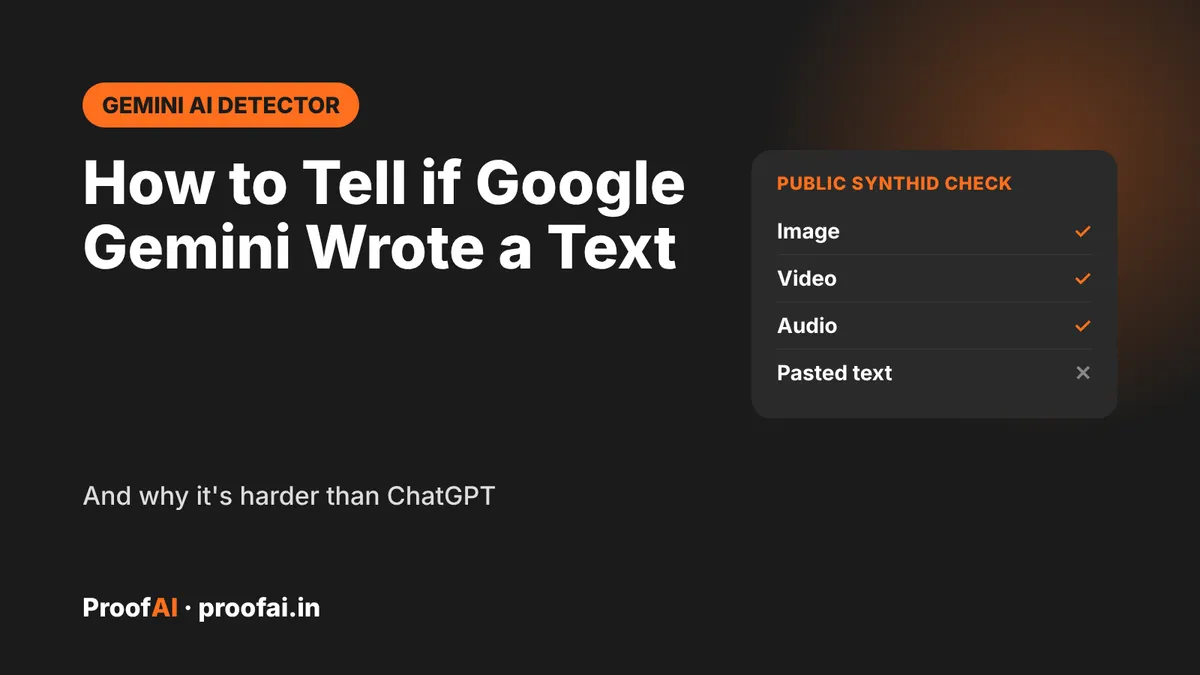
Like every detector, it can be wrong, especially on short, formulaic or heavily edited text. If you want a broader view of how Google handles its own model, see our companion guide on how to tell if Gemini wrote a text.
Checking for Claude: Anthropic's watermark vs an independent detector and a fair review process
A fair way to check a text you suspect
For teachers, editors and recruiters
- Run the text through an independent detector and read the highlighted passages, not just the score.
- Ask for the process: drafts, outlines, notes and the document's version history.
- Talk to the writer about the argument, the sources and the choices they made.
- Check the references. Claims and citations you cannot find are a better reason to ask questions than a writing style.
- Follow your institution's AI policy and write down what you checked and why.
For students and job seekers
- Keep your drafts and version history, and save your Claude conversations if you used it where it was allowed.
- Check your own text before you submit with the AI text detector and rewrite generic passages with your own examples and reasoning.
- Disclose AI use where your course or employer asks you to.
Why no detector is proof
Every method above gives a probability. Anthropic describes its own watermark result as the likelihood that Claude was partly involved (Anthropic). Turnitin says it aims to keep false positives under 1% for documents with over 20% AI writing, which it explains as possibly flagging one in every hundred fully human-written documents (Turnitin). In a large class or hiring round, that is still real people. A detector result should start a conversation, not end one.
FAQ
Is there a Claude AI detector from Anthropic? Not a public one. Anthropic says future Claude models will watermark their text, but its detection API is in private preview for eligible organisations such as regulators, researchers and educational organisations (Anthropic).
Can Turnitin detect Claude? Turnitin lists several Claude models, including Claude Sonnet 4.5 and Claude Opus 4.6, among those its English AI writing detection covers (Turnitin). It also says its score should not be the only basis for action.
Does the Claude watermark prove a student cheated? No. Anthropic says the watermark only indicates that Claude was likely involved, and cannot tell whether Claude wrote a text or heavily edited it (Anthropic). Whether that use was allowed is a question for the course rules.
Can ProofAI detect Claude text? ProofAI's AI text detector is designed to detect text from widely used models, including Claude. Treat the result as one signal and review it together with drafts and a conversation.
What should I do if I am wrongly accused of using Claude? Share your drafts, notes and version history, offer to explain your work and sources, and ask which evidence the concern is based on. Detector scores and chatbot answers are not proof on their own.
Conclusion
Anthropic says future Claude models will carry an invisible watermark, but only approved organisations can check it, and even then it gives a likelihood, not a verdict. Turnitin covers named Claude models, and independent tools like ProofAI give anyone a starting point. Fair decisions still come from drafts, conversation and clear AI rules.
Published by
AI tools may assist with drafting; a team member checks and approves every article before it is published. How we write and correct articles.
Popular AI detection tools
Ready to Verify Your Content?
Get weekly insights on AI detection. Start your journey toward digital authenticity with our AI detection tools.