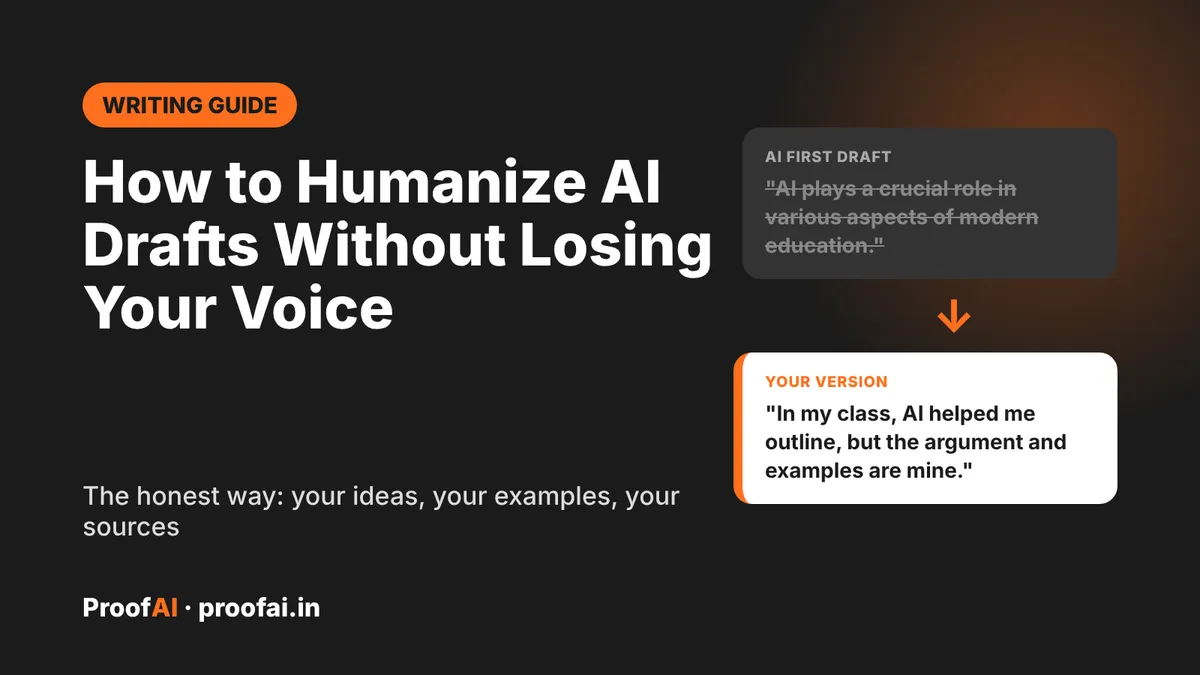
How to Humanize AI Drafts Without Losing Your Voice (the Honest Way)
How to humanize AI text the honest way - turn an AI first draft into writing that is really yours with your own examples, facts, voice and clear disclosure.
Short answer: to humanize AI text honestly, treat the AI output as a rough first draft and rebuild it with what only you can add: your own experience, examples, opinions and sources. Cut the generic filler, vary the rhythm, check every fact, and disclose AI use where your course or employer asks you to. A readability rewriter can help with clarity and tone, and an AI text detector is a useful self-review step. None of this is about fooling a detector. It is about making the writing good and making it yours.
This guide is for students, teachers, job seekers and anyone who writes at work and uses ChatGPT, Gemini or Claude to get started.
Try it: use ProofAI's AI checker tool, free for 10 checks a day with no login.
What "humanizing" should mean
Search for "ai humanizer" and you find two very different ideas. One is editing: taking a stiff, generic draft and turning it into clear writing with a real point of view. The other is disguise: running text through a tool that promises it will be "undetectable". This guide is only about the first.
The difference matters because the reader, not the detector, is who you are writing for. A teacher wants to see your thinking. A hiring manager wants to know what you actually did. A client wants advice that fits their situation. An AI draft cannot supply any of that on its own, because it does not know you, your class, your project or your audience.
Why "undetectable AI" tools are a bad idea
Tools that promise to make AI text undetectable are risky for three reasons.
Want to check your own content? Try ProofAI free 10 checks a day, no login needed.
They can break academic rules. Many universities treat submitting AI-generated work as your own as misconduct. The University of Waterloo's writing centre, for example, says that unless your instructor allows it you should never submit work produced by generative AI, and that doing so is an academic offence (University of Waterloo Writing and Communication Centre). Disguising that work does not change the rule; it adds concealment on top.
Integrity tools now look for them. In 2025 Turnitin added "AI bypasser detection" to its AI writing detection, a feature meant to flag text modified by humanizer tools, and the company described concealing AI use as a growing threat to academic integrity (Campus Technology).
They damage the meaning. Automatic rewording can swap precise terms for odd synonyms. Researchers who studied published papers found "tortured phrases" such as "counterfeit consciousness" in place of "artificial intelligence", produced by paraphrasing software (Cabanac, Labbé and Magazinov, arXiv). A reader who sees phrasing like that stops trusting the whole text.
So the honest route is also the safer one: make the work genuinely yours.
Seven steps to make an AI draft your own
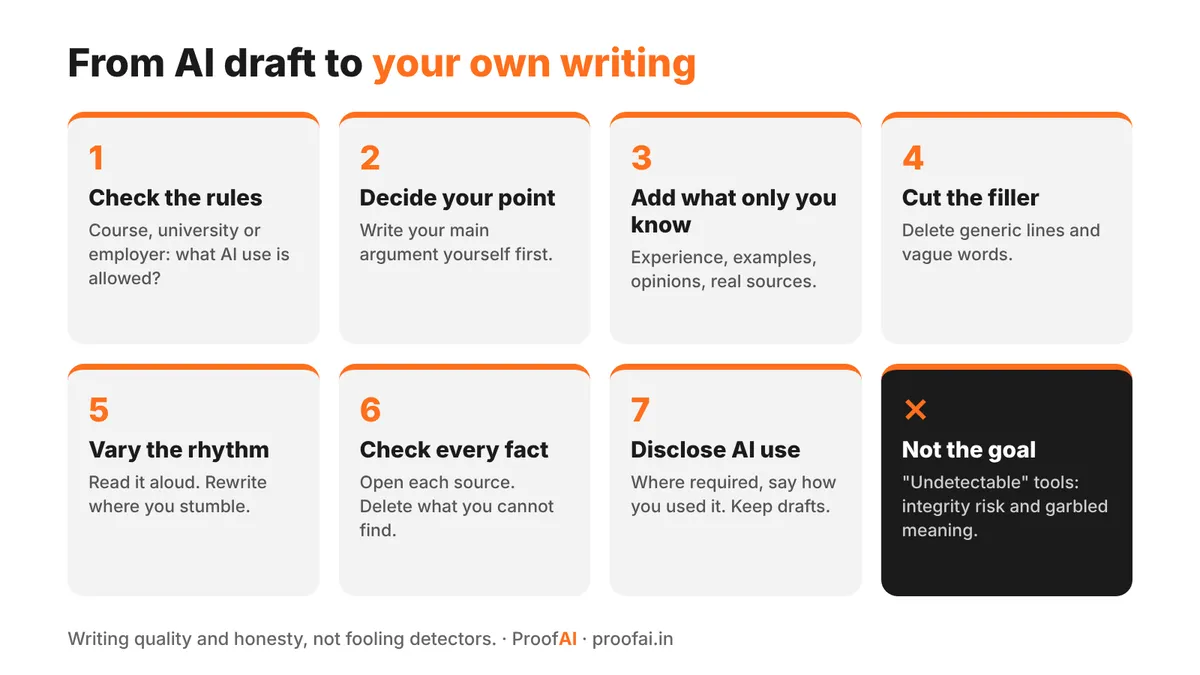
Seven steps to turn an AI first draft into your own writing
1. Check the rules before you start
Find out what your course, university, employer or client allows. Some teachers welcome AI for brainstorming but not for writing; some workplaces ban pasting client data into chatbots. Waterloo's guidance is simple: make sure AI use is allowed for the task, understand the limits, and document and cite how you used it (University of Waterloo).
Also read: Is QuillBot's AI Detector Accurate? What It Checks and Its Limits
2. Decide what you want to say
Before you touch the draft, write down your main point in one or two sentences of your own. If the AI draft argues something different, or nothing at all, the draft follows your point, not the other way round. This one step does more for your voice than any amount of word swapping.
3. Add what only you know
This is where an AI draft becomes yours:
- Experience: what happened when you tried it, taught it, or saw it at work.
- Examples: a case from your class, your city, your company or your field. Indian readers notice when every example is American.
- Opinions: where you agree, where you disagree and why.
- Sources: the readings from your course, the report you actually read, the data you collected.
A paragraph with a specific example and a clear opinion almost never reads as generic.
4. Cut the filler
AI drafts often open with a throat-clearing sentence, repeat the question, stack three adjectives where one would do, and end each section with a summary nobody needed. Delete those lines. Replace vague words ("various", "crucial", "plays a vital role") with the specific thing you mean. If a sentence would fit in any essay on any topic, it probably does not belong in yours.
5. Vary the rhythm and read it aloud
Real writing has short sentences and long ones, a question now and then, and paragraphs of different lengths. Read your draft aloud. Where you stumble or get bored, rewrite in the words you would use if you were explaining it to a friend. That is your voice.
6. Check every fact, quote and reference
Generative AI can produce information that is fabricated but looks authentic, a problem known as hallucination (MIT Sloan Teaching & Learning Technologies). Open every source the draft mentions, confirm the numbers, and delete any reference you cannot find. A made-up citation can do more damage than a weak sentence.
7. Disclose AI use where it is required
If your institution or employer asks you to acknowledge AI help, say what you used and how: brainstorming, outlining, a first draft, or language polishing. Clear disclosure protects you if questions come up later, and keeping your drafts and notes gives you a record of your own work.
Where ProofAI fits
For clarity and tone. The readability rewriter helps when a draft (AI or your own) is stiff, too formal or hard to follow, and it is useful for non-native English writers who want smoother phrasing. It is built for clarity, not for hiding AI use, and it does not change who wrote the ideas. Waterloo's writing centre makes a fair point about any AI editor: suggestions can change your voice or soften a nuance you wanted, so accept only the ones that keep your meaning (University of Waterloo).
As a self-review step. After you have rewritten the draft, run it through the AI text detector. If a passage is highlighted as likely AI-written, read it again: it is often the part where you kept the draft's wording and added nothing of your own. Rewrite it with your own example or argument, not by swapping synonyms.
Limitations: what a detector check can and cannot tell you
A detector result is a probability, not proof, and no detector is always right. Detectors have also been shown to flag writing by non-native English speakers as AI more often than writing by native speakers (Stanford HAI), which matters for anyone who writes in English as a second language. Use the check to find weak, generic passages, and keep your drafts and notes as the real record of your work.
FAQ
How do I humanize AI text without cheating? Use the AI output only as a starting draft, follow your course or employer rules, add your own ideas, examples and sources, check every fact, and disclose AI use where you are asked to. The final text should say what you think, in your words.
Are AI humanizer tools allowed in college? It depends on your institution, but many treat submitting AI-generated work as your own as misconduct, and Turnitin now looks for text modified by humanizer tools (Campus Technology). Ask your teacher before using any AI tool on assessed work.
Will editing an AI draft make it pass an AI detector? That is the wrong goal, and no one can promise it. Edit for the reader: add your own thinking and evidence and cut what is generic. A detector result is only one signal, and your drafts and notes show how the work was made.
Not in the way "undetectable" tools use the word. ProofAI's readability rewriter improves clarity and tone; it is not designed to get text past AI detectors, and it does not replace your own ideas.
How do I keep my own voice when I use ChatGPT? Write your main point yourself before you open the chatbot, use the draft only for structure, and rewrite each paragraph in words you would say out loud. Accept AI edits only when they keep your meaning.
Conclusion
Humanizing an AI draft honestly is just good editing: your point, your examples, your sources and your voice, with every fact checked and AI use disclosed where it is required. Skip the "undetectable" shortcuts; they put your grades or your reputation at risk and make the writing worse. Use a readability tool for clarity and a detector check for self-review, then let the work speak for you.
Published by
AI tools may assist with drafting; a team member checks and approves every article before it is published. How we write and correct articles.

Popular AI detection tools
Ready to Verify Your Content?
Get weekly insights on AI detection. Start your journey toward digital authenticity with our AI detection tools.